
NASA Astronaut Shares Dazzling Aurora From Space, Calls It "Absolutely Spectacular"
The cosmos continually offers breathtaking spectacles, but few rival the ethereal beauty of the aurora seen from the unique vantage point of Earth's orbit. A recent shared experience by a NASA astronaut has once again highlighted this natural wonder, describing the dazzling light show as "absolutely spectacular."
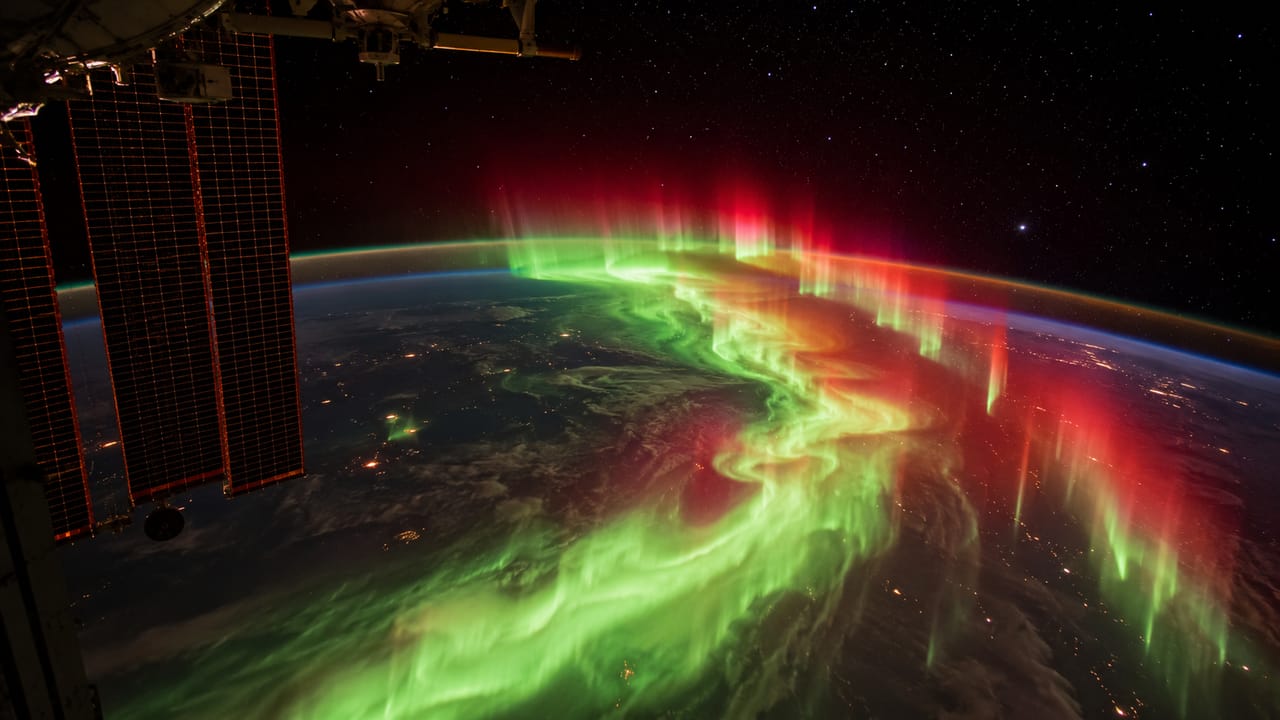
This sentiment resonates with generations of spacefarers who have witnessed the celestial dance firsthand, providing a perspective unlike any on Earth.
The Unparalleled View from the International Space Station
From aboard the International Space Station (ISS), astronauts are privy to a constant parade of Earth's atmospheric phenomena. Among these, the aurora stands out not merely as a light show, but as a dynamic, living curtain of color that stretches across the planet's curvature. Unlike ground-based observers who look up, astronauts look down upon the aurora, seeing its full, three-dimensional structure and vast expanse, often appearing like a glowing green or red river flowing through the upper atmosphere.
The absence of atmospheric scattering, light pollution, and clouds provides an unobstructed, crystal-clear view. This allows for unparalleled photographic opportunities and direct observation of the interaction between solar particles and Earth's magnetic field in a way that ground observations cannot fully capture.
Also Read: Neil deGrasse Tyson Science Quote Explained (With Quiz)
The Science Behind the Spectacle: How Auroras Form
Auroras, both the Aurora Borealis (Northern Lights) and Aurora Australis (Southern Lights), are a captivating display of physics in action. They are the result of collisions between gaseous particles in Earth's atmosphere with charged particles released from the Sun's atmosphere. Here's a breakdown:
- Solar Wind: The Sun constantly emits a stream of charged particles (electrons and protons) known as the solar wind.
- Magnetic Field Interaction: When the solar wind approaches Earth, it encounters our planet's powerful magnetic field, or magnetosphere.
- Funneling to Poles: Most of the solar wind is deflected, but some charged particles are trapped by the magnetosphere and funneled towards the magnetic poles.
- Atmospheric Collisions: As these energetic particles descend into Earth's upper atmosphere, they collide with atoms and molecules of gases like oxygen and nitrogen.
- Light Emission: These collisions excite the atmospheric gases, causing them to emit photons of light. The specific color of the light depends on the type of gas and the energy of the colliding particles.
Colors of the Aurora and Their Origins
| Color | Atmospheric Gas | Altitude Range (Approx.) | Notes |
|---|---|---|---|
| Green | Oxygen | 100-300 km | Most common and easily seen color, produced by lower-energy oxygen collisions. |
| Red | Oxygen | Above 300 km | Less common, produced by higher-energy oxygen collisions at higher altitudes. |
| Blue/Violet | Nitrogen | Below 100 km | Often seen at the lower edges of auroras, requires more energetic particles. |
| Pink/Purple | Mix of Oxygen & Nitrogen | Varies | A combination of red/green/blue emissions. |
Aurora Borealis vs. Aurora Australis: A Global Phenomenon
While often colloquially referred to as the "Northern Lights," auroras are a global phenomenon, occurring simultaneously in both the Northern and Southern Hemispheres. Their characteristics are remarkably similar, reflecting the symmetrical nature of Earth's magnetic field.
| Feature | Aurora Borealis (Northern Lights) | Aurora Australis (Southern Lights) |
|---|---|---|
| Location | Visible in high-latitude regions of the Northern Hemisphere (e.g., Alaska, Canada, Scandinavia, Russia). | Visible in high-latitude regions of the Southern Hemisphere (e.g., Antarctica, Tasmania, New Zealand, Southern Argentina/Chile). |
| Best Viewing Seasons | Autumn and Winter (September to March) in the Northern Hemisphere. | Autumn and Winter (March to September) in the Southern Hemisphere. |
| Cause | Charged particles from solar wind interacting with Earth's magnetosphere near the North Magnetic Pole. | Charged particles from solar wind interacting with Earth's magnetosphere near the South Magnetic Pole. |
| Appearance | Identical colors and forms to the Aurora Australis, often green, red, blue, purple. | Identical colors and forms to the Aurora Borealis. |
Also Read: Science Breakthroughs & Innovations Quiz: This Week's Discoveries
The Significance for Science and Human Endeavor
Beyond their stunning visual appeal, auroras are vital for scientific research. Studying these displays helps scientists understand space weather, the complex interactions between the Sun and Earth, and the dynamics of our planet's magnetosphere. This knowledge is crucial for protecting satellites, communication systems, and even power grids from solar storms.
For astronauts, witnessing such a powerful display from above is often a profound experience, connecting them deeply to the planet they orbit and the vastness of space beyond. It serves as a constant reminder of Earth's fragility and its incredible natural processes, fostering a sense of awe that transcends scientific data.
Conclusion
The "absolutely spectacular" aurora witnessed by a NASA astronaut from space is more than just a beautiful image; it's a testament to the intricate dance between our Sun and Earth. It highlights the unique perspective offered by space exploration and underscores the continuous marvels that await humanity as we push the boundaries of discovery. Whether seen from a frigid polar landscape or from the silent vacuum of orbit, the aurora remains one of nature's most captivating and scientifically significant performances.
Quiz: NASA Astronaut Shares Dazzling Aurora From Space
Test your knowledge about auroras and their stunning appearance from space!
Start Quizzes [MCQs]
REPORT CARD
ATTEMPTED QUESTIONS: 0CORRECT ANSWERS: 0
WRONG ANSWERS: 0
PRACTICE REGULARLY!
Frequently Asked Questions
What causes the aurora to appear in different colors?
The color of the aurora depends on the type of atmospheric gas being excited and the altitude at which the collisions occur. Oxygen atoms typically produce green light at lower altitudes (100-300 km) and red light at higher altitudes (above 300 km). Nitrogen molecules produce blue or violet light at lower altitudes.
Why is the aurora seen from space considered 'spectacular'?
From space, astronauts have an unparalleled view of the aurora's full three-dimensional structure and vast extent, stretching across the Earth's curvature. This perspective is free from atmospheric scattering, light pollution, and clouds, offering a clearer and more comprehensive sight than what is visible from the ground.
Are auroras only visible in the Northern Hemisphere?
No, auroras are a global phenomenon. While the Northern Lights are called Aurora Borealis, identical light displays occur simultaneously in the Southern Hemisphere, known as the Aurora Australis (Southern Lights), around the south magnetic pole.