
Meet Ernest: Nasa's Next-Generation Lunar Rover Accelerates Towards the Moon
Nasa is gearing up for its most ambitious lunar explorations yet, with a new four-wheeled rover named Ernest set to revolutionize our understanding of the Moon's challenging polar regions. Recently tested in the arid landscapes of California, Ernest demonstrated a remarkable speed, surpassing the capabilities of its Mars counterpart, the Perseverance rover, by a factor of ten.
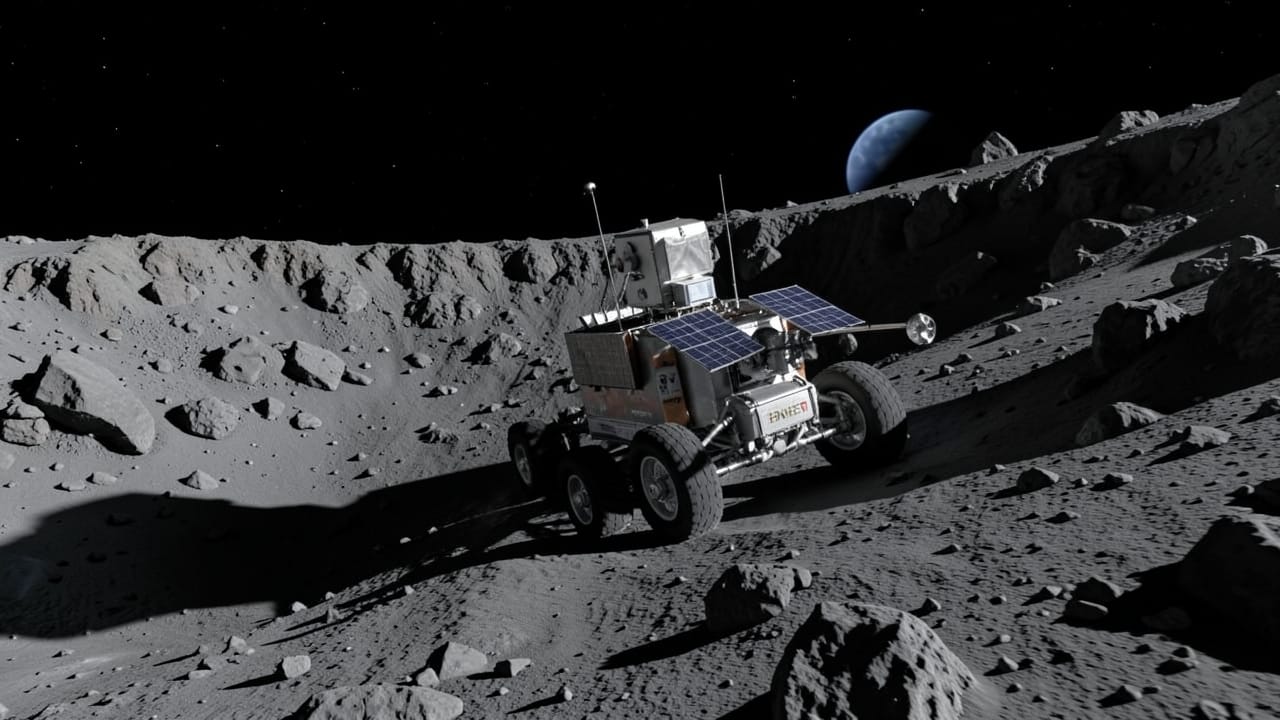
This advanced prototype is designed to tackle extreme terrains and navigate in the perpetual darkness characteristic of lunar poles, paving the way for unprecedented scientific discovery.
Also Read: Titan: The Ultimate Space Outpost? NASA Scientist Explains
From California Deserts to Lunar Polar Craters
In March 2026, the Ernest rover, whose full designation is Exploration Rover for Navigating Extreme Sloped Terrain, conducted rigorous field tests in the Colorado Desert near Plaster City, California. This strategically chosen location mimics some of the harsh conditions anticipated on the Moon. Developed at Nasa's Jet Propulsion Laboratory (JPL), Ernest serves as a crucial testbed for advanced autonomy software, enabling it to make independent driving decisions and navigate complex environments without direct human control from Earth.
Unparalleled Mobility and Speed
Ernest's design prioritizes conquering challenging, sloped terrains—the very kind of treacherous surfaces that have historically posed significant obstacles for robotic explorers. Its sophisticated mobility system ensures exceptional stability and grip, even when one wheel is elevated on a rock. This capability is vital for reaching scientifically compelling locations like crater rims and canyon floors.
During its 37-hour traverse in the California desert, Ernest covered approximately 16 miles. This translates to a speed significantly higher than that of Nasa's Perseverance rover on Mars, which operates at a much more cautious pace due to the planet's thin atmosphere and the extreme distances involved in remote operation. Ernest's impressive speed and endurance are critical for future lunar missions, which will require rovers capable of covering greater distances more rapidly.
| Rover | Mission Location | Approximate Speed Factor | Primary Challenge |
|---|---|---|---|
| Ernest | Moon (Polar Regions) | 10x faster than Perseverance | Extreme Sloped Terrain, Deep Shadows |
| Perseverance | Mars | 1x (Baseline) | Thin Atmosphere, Communication Delay |
Also Read: Neil deGrasse Tyson Science Quote Explained (With Quiz)
Navigating the Lunar Night: A Test in Darkness
A key aspect of Ernest's development involves its ability to operate in environments with extremely limited visibility. Nasa engineers intentionally conducted tests at night, from dusk till dawn, to simulate the long, deep shadows found in the Moon's polar regions. These shadows can obscure the terrain and pose significant challenges for a rover's visual navigation systems.
By training Ernest to interpret and navigate these light-starved scenes, engineers are ensuring its capability to traverse safely in areas where conventional imaging would fail. This skill is paramount for accessing scientifically rich areas that remain perpetually shrouded in darkness.
Funding and Future Prospects
The development of the Ernest rover commenced in 2022, initially funded through internal JPL resources. Its ongoing development is now supported by Nasa's Mars Exploration Program, underscoring the technological synergies between lunar and Martian exploration initiatives. The successful completion of these terrestrial trials marks a significant milestone, bringing the prospect of autonomous, high-speed lunar exploration closer to reality. As Ernest transitions from the deserts of Earth to the challenges of the Moon, it promises to unlock new frontiers in our quest to understand the solar system.
Start Quizzes [MCQs]
REPORT CARD
ATTEMPTED QUESTIONS: 0CORRECT ANSWERS: 0
WRONG ANSWERS: 0
PRACTICE REGULARLY!
Frequently Asked Questions
What is the primary advantage of Nasa's Ernest rover over the Perseverance rover?
Ernest is approximately 10 times faster than Perseverance.
What does the acronym ERNEST stand for?
ERNEST is an acronym for Exploration Rover for Navigating Extreme Sloped Terrain, highlighting its specific design purpose.
Where were the primary field tests for the Ernest rover conducted?
The rover was tested in the Colorado Desert near Plaster City, California, to simulate challenging terrestrial conditions.
What is a key technological advancement Ernest is testing?
Ernest is a testbed for autonomy software, which allows the rover to drive and make decisions without direct Earth control.
Why did Nasa test Ernest in the dark during its field trials?
The dark-phase testing was specifically designed to prepare Ernest for navigating the long, deep shadows found in the Moon's polar regions, where visibility is extremely limited.
What specific lunar terrain is Ernest designed to conquer?
Ernest's name itself, Exploration Rover for Navigating Extreme Sloped Terrain, indicates its primary design purpose: to tackle steep, rocky, and challenging lunar surfaces.
How far did Ernest travel during its 37 hours of drive time in the California desert?
During the field test, Ernest covered a distance of about 16 miles over 37 hours of operational time.
Which Nasa laboratory is responsible for building the Ernest rover prototype?
The Ernest rover prototype was built at Nasa's Jet Propulsion Laboratory (JPL), known for its robotic exploration missions.
What is the significance of Ernest's speed for future lunar missions?
Ernest's enhanced speed is vital for future lunar missions, allowing rovers to traverse larger areas and achieve scientific goals more efficiently.
What program is currently backing the development of the Ernest rover after initial internal funding?
Although Ernest is intended for the Moon, its development is currently backed by Nasa's Mars Exploration Program, likely due to shared technological advancements in rover autonomy and mobility.