
Titan: Saturn's Hydrocarbon-Rich Moon – A Future Hub for Space Exploration?
Saturn's largest moon, Titan, a world shrouded in a thick, hazy atmosphere, is increasingly being eyed by NASA scientists not just as a destination for robotic exploration, but as a potential cornerstone for humanity's expansion into the outer solar system.
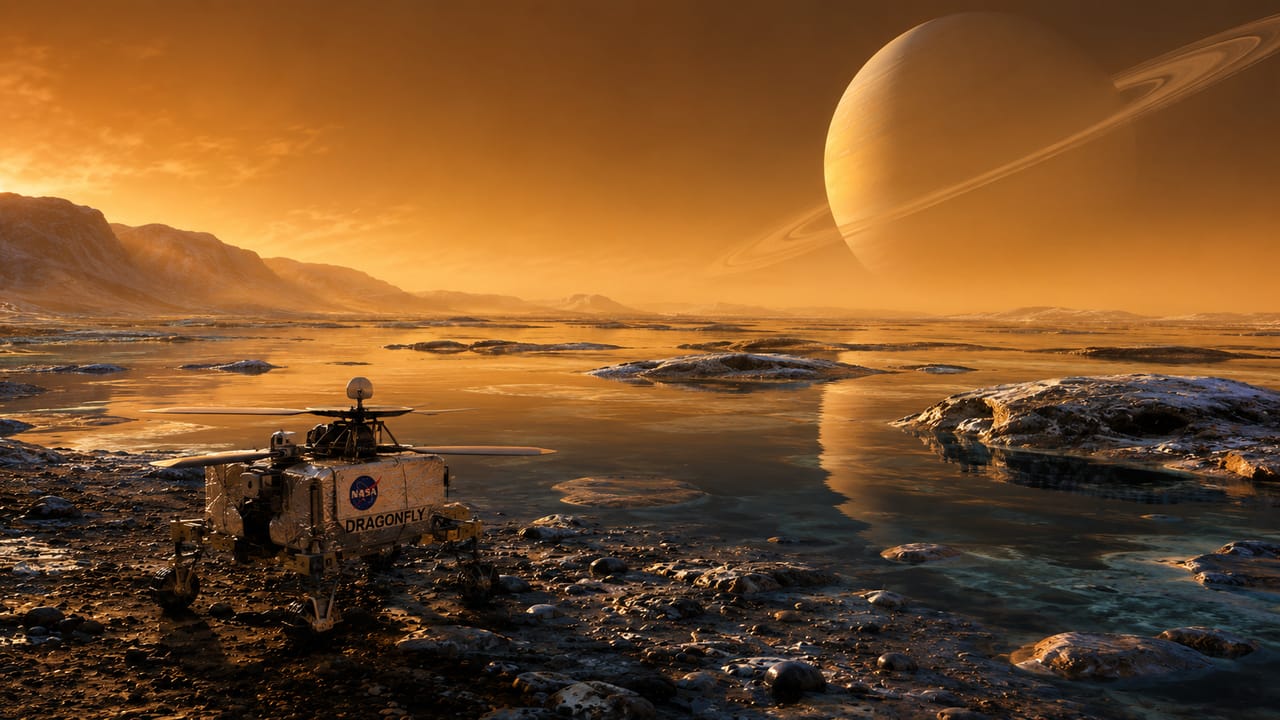
While the upcoming Dragonfly mission is set to provide unprecedented insights, researchers are already envisioning Titan's role in a long-term, off-world future.
An Atmosphere and Abundant Resources Unlike Any Other Moon
Titan stands out in our solar system for a remarkable feature: it's the only known moon with a substantial atmosphere. This atmosphere, primarily composed of nitrogen, is remarkably dense – about 50% denser than Earth's at sea level. Beyond its atmospheric significance, Titan is a treasure trove of complex hydrocarbons, essentially the building blocks for fuels and materials that are scarce on other celestial bodies like the Moon or Mars.
Also Read: Science Breakthroughs & Innovations Quiz: This Week's Discoveries
The Power of In Situ Resource Utilization (ISRU) on Titan
The concept of In Situ Resource Utilization (ISRU) is central to making long-duration space missions feasible and sustainable. Instead of expending vast resources to transport everything from Earth, ISRU advocates for leveraging local materials. While much attention has been given to ISRU on the Moon and Mars, Titan presents a unique and compelling case, according to NASA Goddard Space Flight Center astronomer Conor Nixon and his team.
In a paper undergoing peer review, Nixon’s team highlights Titan's “useful resources” as a game-changer for deep space endeavors. “This combination of abundant reduced carbon, along with available nitrogen and oxygen makes Titan an enticing world rich in resources that can be readily used to make food, fuel, building materials and more — potentially mission-enabling for long-duration voyages or habitats in the outer solar system,” the paper states.
Also Read: June 20 Moon Phase: Stargazing Guide & Astronomy
Titan's Hydrocarbon Advantage: Fuel, Plastics, and More
“Titan is gushing with hydrocarbons — what we call oil and natural gas on Earth,” Nixon told Universe Today. Unlike the Moon or Mars, where creating vital compounds like methane for rocket fuel requires complex, multi-step processes, Titan offers them in abundance.
On Titan's surface, liquid rivers and lakes of methane and ethane flow. Heavier hydrocarbons, such as propane and butane, are readily available, serving as crucial feedstocks. Nixon elaborates, “Besides burning these hydrocarbons, we can also make a lot of products from them: plastics, synthetic rubber, and feedstocks for everything from solvents to pharmaceuticals, and even foods.” This makes Titan a potential refueling station and manufacturing hub for missions venturing further into the solar system.
Comparing Resource Potential: Titan vs. Moon & Mars
| Resource Type | Titan | Moon | Mars |
|---|---|---|---|
| Hydrocarbons (Methane, Ethane, Propane, etc.) | Abundant (liquid & gas) | Scarce | Trace amounts (mainly atmospheric CO2) |
| Nitrogen | Abundant (atmosphere) | Trace amounts | Abundant (atmosphere) |
| Oxygen | Requires electrolysis (from water ice or CO2) | Requires electrolysis (from water ice or oxides) | Requires electrolysis (from water ice or CO2) |
| Water Ice | Abundant (subsurface) | Present (polar caps, permanently shadowed craters) | Present (polar caps, subsurface ice) |
| Building Materials | Hydrocarbon-based plastics, potential use of ice | Regolith (soil) | Regolith (soil) |
Challenges and Future Prospects
Despite its advantages, establishing a presence on Titan is not without significant hurdles. The moon's surface temperature hovers around a frigid -290 degrees Fahrenheit (-179 degrees Celsius), allowing for the existence of liquid methane and ethane rivers. The atmospheric pressure is higher than Earth's, and the gravity is much weaker (about one-seventh of Earth's). Furthermore, while nitrogen is abundant, breathable oxygen would need to be produced, likely through electrolysis.
However, Nixon posits that even if permanent settlements are a distant dream, Titan's potential as a strategic stopover point is immense. It could serve as a vital resupply station, providing everything from rocket fuel synthesized from local hydrocarbons to raw materials for manufacturing – even items as diverse as "printer ink to fertilizer." This concept is crucial for enabling more ambitious, long-duration missions into the outer reaches of the solar system.
The Vision for Titan's Role in Space Exploration
While current and planned robotic missions, like Dragonfly, focus on exploration rather than resource utilization, the scientific community recognizes the long-term potential. “While such visions are speculative for the time being the unique resources available on Titan in the outer solar system imply that eventually missions will be developed to take advantage of them,” the paper concludes. Titan's unique combination of a thick atmosphere and abundant organic compounds positions it as a uniquely valuable asset for humanity's future in space.
Start Quizzes [MCQs]
REPORT CARD
ATTEMPTED QUESTIONS: 0CORRECT ANSWERS: 0
WRONG ANSWERS: 0
PRACTICE REGULARLY!
Frequently Asked Questions
What makes Saturn's moon Titan unique among known satellites in our solar system?
Titan is the only moon in our solar system known to have a thick, dense atmosphere, primarily composed of nitrogen.
According to NASA scientist Conor Nixon, what is a primary resource abundant on Titan?
Titan is rich in complex hydrocarbons like methane, ethane, propane, and butane, which can be used as fuel and raw materials.
What does the concept of In Situ Resource Utilization (ISRU) refer to in space exploration?
ISRU is the practice of using materials available at a mission destination (like Titan) to reduce the cost and complexity of space exploration.
How does Titan's hydrocarbon availability compare to that of the Moon or Mars for activities like rocket fuel production?
Titan possesses vast reservoirs of liquid and solid hydrocarbons, making it a prime location for fuel production, unlike the Moon and Mars where such resources are scarce.
What are some potential non-fuel products that can be manufactured from Titan's hydrocarbons?
Titan's hydrocarbons can be processed into a wide array of products, including plastics, synthetic rubber, and precursors for solvents, pharmaceuticals, and even food items.
What is the average surface temperature on Titan?
Titan's average surface temperature is extremely cold, around -290 degrees Fahrenheit (-179 degrees Celsius), which allows methane and ethane to exist as liquids.
What is a major challenge for human survival on Titan that would require technological solutions?
While Titan has a dense atmosphere, it lacks sufficient breathable oxygen for humans, requiring production via methods like electrolysis.
Besides fuel, what else could Titan be a source for, according to Nixon's arguments?
Nixon suggests Titan could supply various raw materials, from printer ink components to fertilizer ingredients, by processing its abundant organic compounds.
What is the significance of Titan's atmospheric pressure compared to Earth's?
Titan's atmosphere is about 50 percent denser (higher pressure) at the surface than Earth's atmosphere at sea level.
What is the main purpose of the NASA Dragonfly mission mentioned in the article?
The Dragonfly mission is a planned robotic mission designed to fly to various locations on Titan's surface to study its prebiotic chemistry and potential habitability.