
Bacteriophages, or phages, have long been represented as the minimalist entities of the biological world. Traditionally characterized by compact genomes and simplistic protein shells, these bacterial viruses have served as fundamental model systems for molecular biology.
From proving that DNA is the carrier of genetic information to fueling the CRISPR-Cas gene-editing revolution, phages have consistently redefined our understanding of life. However, the discovery of jumbo phages and megaphages has completely shattered the classical paradigm of viral simplicity.
Jumbo phages are viral giants with double-stranded DNA (dsDNA) genomes exceeding 200 kilobases (kb). Some exceptional specimens, known as megaphages, possess genomes stretching beyond 500 kb, with the largest known genomes reaching up to 735 kb—surpassing the genome sizes of several parasitic and symbiotic bacteria. These structural marvels possess expansive genetic repertoires, complex eukaryotic-like cellular structures, and unique replication cycles that challenge the boundaries of what defines a virus.
Defining Genomic Gigantism in the Phage World
While the average bacteriophage genome hovers around 52 kb, jumbo phages exhibit massive genetic architectures. This genomic expansion corresponds to highly complex virion structures. For instance, the infamous Lysinibacillus phage G measures approximately 455 nm from its head to the tip of its tail, with a capsid head diameter of roughly 180 nm. To put this in perspective, multiple G phages could fit end-to-end inside a single cell of Escherichia coli.
To understand how these colossal entities compare to standard viral agents and their host bacteria, we can look at their genomic and structural dimensions:
| Phage Category | Genome Size Range | Structural Characteristics | Representative Examples |
|---|---|---|---|
| Standard Phages | Generally < 200 kb (Average ~52 kb) | Compact capsids, rapid replication, limited accessory genes. | Coliphage T4, Lambda phage |
| Jumbo Phages | 200 kb to 500 kb | Enlarged capsids, self-encoded multi-subunit RNA polymerases (RNAPs), extensive replication machinery. | Pseudomonas phage phiKZ, Phage G |
| Megaphages | > 500 kb (up to 735 kb) | Massive capsids, found frequently in gut microbiomes and marine systems, complex metabolic gene cassettes. | Prevotella megaphages, Mar_Mega_1 |
Also Read: Bundibugyo Ebola Vaccines & Treatments: Outbreak Guide + Quiz
Ecological Distribution and the Filtration Bias
Historically, scientific literature severely underrepresented jumbo phages. This was not due to their scarcity in nature, but rather a direct consequence of traditional laboratory isolation protocols. Classic virology workflows rely on physical filtering steps (typically using 0.22 μm filters) to separate bacterial cells from viral particles. Because of their immense physical dimensions, jumbo phages are frequently trapped on these filters alongside their bacterial hosts, completely excluding them from downstream analyses.
Furthermore, their physical bulk prevents efficient diffusion through standard agar media, making them fail to produce the clear, visible plaques typically used to confirm phage presence. Despite these methodological hurdles, modern metagenomics and filter-free isolation techniques have revealed that jumbo phages are ubiquitous. They have been isolated from an astonishing array of environments, including:
- Agricultural soils and compost heaps
- Marine sediments and deep-ocean ecosystems
- Animal and human gut microbiomes (especially gut-associated Prevotella phages)
- Extreme environments like hydraulic fracturing wastewater and deep shale formations
- Clinical environments, targeting highly pathogenic bacteria such as Pseudomonas aeruginosa, Staphylococcus aureus, and Salmonella enterica
Evolutionary Origins and Speciation Dynamics
Phylogenetic reconstructions indicate that jumbo phages did not evolve from a single, ancestral giant virus. Instead, genomic gigantism arose multiple times independently—at least 19 distinct times—from smaller, tailed phage ancestors (predominantly within myovirus-like lineages). This evolutionary trajectory is believed to be driven by adaptive mutations in capsid-encoding genes that increased internal volume, allowing the virion to package larger, duplicated genomic sequences and genes acquired via horizontal gene transfer (HGT).
Jumbo phages utilize unique mechanisms to promote genetic isolation and fuel speciation, preventing genomic dilution during co-infection with other viruses:
- Subcellular Genetic Isolation: By compartmentalizing their replication cycle inside a specialized protein shell (the pseudo-nucleus), certain jumbo phages physically isolate their genomes from competing viruses, eliminating opportunities for recombination.
- Virogenesis Incompatibility: During co-infection of a single host by different jumbo phages, essential structural components can interfere with one another. For instance, the tubulin-like PhuZ monomers of closely related phages (like phiPA3 and phiKZ) co-assemble into non-functional hybrid filaments. This prevents the proper positioning of the replication machinery, acting as a post-infection barrier that forces evolutionary divergence.
- Homing Endonucleases: Many jumbo phages encode competitive homing endonucleases that specifically target and cleavage the genes of rival phages, actively eliminating biological competitors inside the host cell.
Also Read: Congo Ebola Outbreak: Key Facts & MCQs Quiz
The Chimalliviridae: Architects of the Phage Pseudo-Nucleus
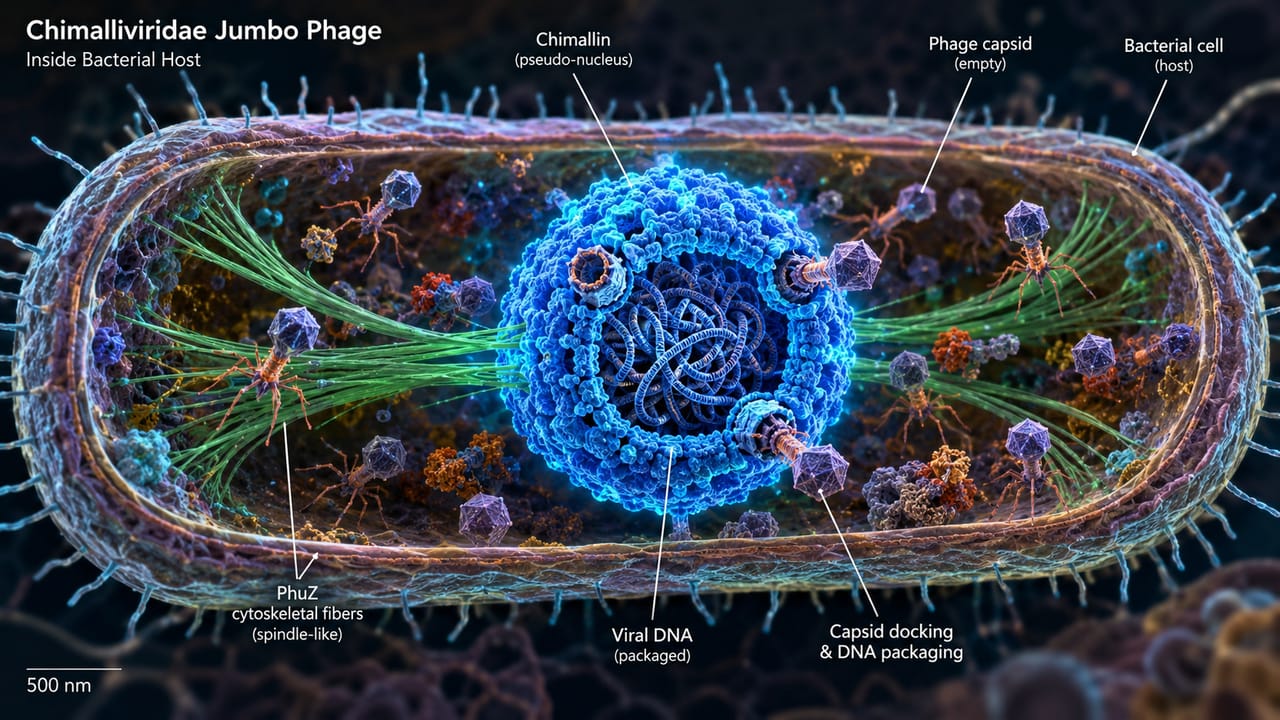
Among the most biologically fascinating families of jumbo phages is the Chimalliviridae. These phages are characterized by their ability to construct a proteinaceous, eukaryotic-like nuclear shell (or pseudo-nucleus) inside their bacterial host. This structure is built primarily from a single, highly conserved protein known as chimallin.
The pseudo-nucleus acts as a specialized compartment, physically separating transcription from translation. While viral DNA replication and mRNA transcription occur inside the chimallin shell, translation of viral proteins takes place in the host cytoplasm. Specialized proteins facilitate the selective transport of macromolecules across this protein boundary, mimicking the nuclear pore complexes of eukaryotic cells.
| Key Protein Component | Functional Role inside Host | Eukaryotic Analog |
|---|---|---|
| Chimallin | Self-assembles to form the closed pseudo-nuclear shell, enclosing the viral genome. | Nuclear Envelope / Lamins |
| PhuZ | Tubulin-like cytoskeletal protein that forms dynamic, treadmill-like filaments to position the phage nucleus in the center of the bacterial cell. | Microtubules / Spindle Apparatus |
| Virion RNA Polymerase (vRNAP) | Pre-packaged within the phage capsid; initiates immediate, host-independent transcription of early viral genes upon genome injection. | Eukaryotic RNA Polymerase II |
The Intricate Chimalliviridae Life Cycle
The lifecycle of a Chimalliviridae jumbo phage is a masterclass in spatial organization. Rather than allowing its genome to float freely inside the host cytoplasm, the phage orchestrates a complex, multi-compartment developmental program:
1. Adsorption and Genome Injection
The jumbo phage recognizes and attaches to specific surface receptors on the host bacterium. Because the viral head contains not only the massive dsDNA genome but also pre-packaged proteins, it injects both its DNA and several copies of its self-encoded virion RNA polymerase (vRNAP) into the cell.
2. Compartmentalization and Centralization
Immediately upon entry, the early infection vesicle forms, and chimallin monomers self-assemble around the injected viral genome to construct the pseudo-nuclear shell. Concurrently, the phage-encoded cytoskeletal protein, PhuZ, begins forming long, dynamic filaments. These filaments extend from the poles of the bacterium, dynamically searching for and centering the phage nucleus within the host cell. This central positioning optimizes the distribution of resources and coordinates the assembly of progeny virions.
3. Transcription, Translation, and Packaging
The transcription machinery operates exclusively inside the safety of the chimallin shell, utilizing both injected vRNAPs and newly synthesized, phage-encoded polymerases. Newly transcribed viral mRNAs are exported through specialized pores in the chimallin shell into the host cytoplasm, where host ribosomes translate them into viral structural proteins.
Empty capsids assemble in the cytoplasm and migrate to the surface of the pseudo-nucleus. Here, the packaging machinery translocates replicated viral DNA directly from the inside of the protein shell into the empty viral heads. Once packaging is complete, tails are attached, and the mature virions accumulate until the host cell is lysed, releasing hundreds of new viral giants.
An Unbreachable Fortress: Evading Bacterial Immunity
The evolutionary arms race between bacteria and phages has driven the development of highly sophisticated bacterial defense mechanisms, including Restriction-Modification (R-M) systems and CRISPR-Cas. These defense systems rely on recognizing and cleaving foreign, naked DNA introduced into the cytoplasm.
The Chimalliviridae pseudo-nucleus acts as an unbreachable physical barrier against these defenses. Because the viral DNA is completely encapsulated within the proteinaceous chimallin shell throughout the replication cycle, cytoplasmic host immune complexes like Cas9, Cas12, or restriction enzymes simply cannot access the viral genome. As a result, jumbo phages exhibit broad-spectrum resistance to almost all DNA-targeting bacterial immune systems. This extraordinary survival mechanism makes them highly effective killers of even the most highly armed bacterial pathogens.
Biotechnological and Therapeutic Horizons
- Phage Therapy Advantages: Due to their physical shielding against host immune systems, jumbo phages can successfully infect bacteria that are entirely resistant to smaller, traditional phages. Their wide host-range capabilities and ability to disrupt biofilms make them prime candidates to combat multi-drug resistant (MDR) bacterial infections.
- Genomic Modification Challenges: The very defense mechanism that keeps jumbo phages safe—the pseudo-nuclear shell—presents a major roadblock for researchers. Standard genetic engineering tools (such as CRISPR-based editing) cannot access the viral DNA inside the shell, making jumbo phages notoriously difficult to genetically modify or engineer for synthetic biology applications.
- Novel Enzymatic Toolkits: Characterizing the unique transcription, replication, and macromolecular transport machineries of jumbo phages is bound to yield a treasure trove of novel enzymes, potentially matching or exceeding the impact that restriction enzymes and CRISPR-Cas have had on biotechnology.
Jumbo Phages MCQs
Test your understanding of the complex biology, structures, and lifecycles of jumbo bacteriophages with this interactive 10-question multiple-choice quiz.
REPORT CARD
ATTEMPTED QUESTIONS: 0CORRECT ANSWERS: 0
WRONG ANSWERS: 0
PRACTICE REGULARLY!
Frequently Asked Questions
What is a jumbo phage?
A jumbo phage is a class of bacteriophage with double-stranded DNA genomes exceeding 200 kilobases (kb) up to 735 kb, featuring exceptionally large physical virion dimensions.
How do jumbo phages evade CRISPR-Cas host defenses?
Phages in the Chimalliviridae family form a proteinaceous pseudo-nucleus shell made of chimallin that physically encloses and shields the viral DNA, blocking cytoplasmic host immune complexes like CRISPR-Cas and restriction enzymes from accessing the genome.
Why are jumbo phages hard to isolate using traditional methods?
Their massive structural size prevents them from passing through standard 0.22 micrometer physical filters, and they diffuse poorly in agar, meaning they often do not form recognizable plaques in traditional viral assays.