
Relativity Space Secures Pivotal NASA Mars Contract, Bolstering 3D-Printed Future Under Strategic Influence
Relativity Space, the pioneering aerospace company renowned for its innovative approach to rocket manufacturing through large-scale 3D printing, has reportedly secured a significant contract with NASA for Mars-related missions.
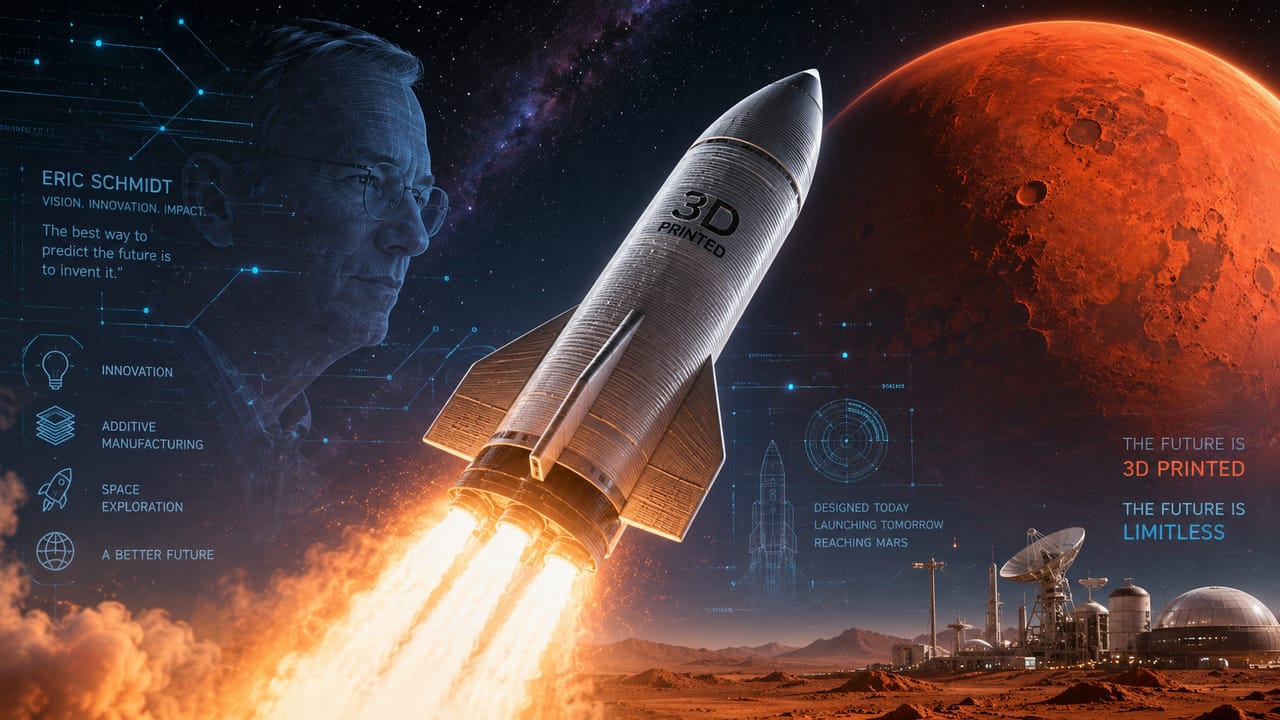
This achievement not only marks a major milestone for the burgeoning space firm but also underscores the strategic impact of prominent figures like former Google CEO Eric Schmidt, whose vision and backing continue to shape the frontier of commercial space exploration. This contract positions Relativity Space at the forefront of the next generation of space travel, leveraging its unique additive manufacturing capabilities to potentially revolutionize our approach to Mars and beyond, much like how AI is changing daily life through rapid technological innovation.
The Rise of Relativity Space and 3D-Printed Rockets
Founded by Tim Ellis and Jordan Noone, Relativity Space embarked on an audacious mission: to entirely 3D-print rockets. Their proprietary 'Stargate' manufacturing platform is touted as the largest metal 3D printer in the world, capable of fabricating a rocket from raw material to flight readiness in a matter of months. This disruptive approach aims to drastically reduce part count, increase manufacturing speed, lower costs, and enhance design flexibility, ultimately making space access more attainable and agile.
Also Read: 12 best free courses to boost your career in 2026
Key Innovations of Relativity Space:
- Stargate 3D Printers: Massive, robotic additive manufacturing systems that can print large-scale rocket structures, including tanks and engines.
- Proprietary Alloys: Development of custom, high-strength metal alloys specifically optimized for the 3D printing process and the extreme conditions of spaceflight.
- Terran 1 & Terran R: Their line of rockets. Terran 1 was notable as the first entirely 3D-printed rocket to attempt an orbital launch, validating the core technology. Terran R is a larger, reusable next-generation rocket designed for heavier payloads and more ambitious deep-space missions, including potential crewed missions.
Also Read: The Smart Advice: 5 Best Formulas to Transform Life and Career
Revolutionizing Rocket Manufacturing: Traditional vs. 3D Printing
Relativity Space's additive manufacturing process offers distinct advantages over conventional rocket fabrication techniques:
| Feature | Traditional Rocket Manufacturing | Relativity Space's 3D Printing (Stargate) |
|---|---|---|
| Part Count | Hundreds of thousands to millions | Fewer than 1,000 (Terran 1) |
| Manufacturing Time | Years | Months |
| Design Complexity | Limited by machining capabilities; multiple welded assemblies | High design freedom; complex geometries integrated into single parts |
| Tooling Requirements | Extensive, custom tooling and jigs | Minimal tooling, primarily the printer itself |
| Cost Efficiency | High initial setup and recurring labor costs | Lower recurring costs, automated process, reduced supply chain complexity |
| Supply Chain | Complex, global network of specialized suppliers | Simplified, largely in-house material handling and production |
The Significance of the NASA Mars Contract
While specific details of the NASA Mars contract remain to be fully disclosed, its implication is profound for both Relativity Space and the broader landscape of space exploration. NASA's increasing interest in commercial partners for Mars exploration signals a broader strategic shift to leverage private sector innovation and efficiency. For Relativity Space, this contract could entail:
- Payload Delivery: Transporting scientific instruments, small probes, or experimental hardware to Mars orbit or its surface.
- Technology Demonstrations: Utilizing 3D-printed components or structures in a Mars environment to test their durability and functionality for future human missions. This could involve demonstrating in-situ resource utilization (ISRU) capabilities or proving the resilience of advanced materials.
- Infrastructure Development: Potentially laying the groundwork for future Martian habitats or resource extraction, perhaps even involving 3D-printed components manufactured on-site using local Martian regolith (a longer-term vision).
This collaboration aligns seamlessly with NASA's long-term vision for sustainable lunar and Martian exploration, particularly under initiatives like the Artemis program, which aims to return humans to the Moon and establish a foundation for subsequent Mars missions. The ability of Relativity Space to rapidly iterate and produce complex, robust structures could prove invaluable in these ambitious endeavors.
Eric Schmidt's Strategic Leadership and Influence
The mention of Eric Schmidt's leadership is particularly noteworthy. While not directly serving as CEO or operational head of Relativity Space, Eric Schmidt, through his various ventures and philanthropic initiatives like Schmidt Futures and Innovation Endeavors, has been a significant investor and strategic advisor in the tech and aerospace sectors. His involvement often signals strong confidence in a company's potential and provides invaluable guidance, resources, and credibility. Such visionary mentorship often highlights how mastering emotional intelligence for career growth is critical for leaders navigating high-stakes industries.
Impact of Schmidt's Backing:
- Capital Infusion: Providing substantial investment crucial for scaling R&D, manufacturing capabilities, and attracting top talent.
- Strategic Guidance: Offering invaluable insights from his vast experience at Google and other major tech companies regarding growth strategies, market positioning, and technological innovation.
- Credibility and Network: Lending the company a high degree of credibility within the investor community and opening doors to a powerful network of industry leaders, policymakers, and potential partners.
- Visionary Alignment: Schmidt's long-standing interest in advanced technology and its application to solve grand challenges aligns well with Relativity Space's mission to enable humanity's multi-planetary future.
The Road to Mars: A Collaborative Future
The contract between NASA and Relativity Space symbolizes a growing trend where government space agencies increasingly rely on the agility, innovation, and cost-effectiveness of private companies. This public-private partnership model is crucial for accelerating the pace of space exploration, particularly for ambitious and complex missions to Mars. By fostering competition and leveraging cutting-edge private sector technologies, NASA can achieve its goals more efficiently and sustainably.
Potential Benefits of Commercial Partnerships for Mars:
- Cost Reduction: Commercial entities often operate with greater efficiency and innovative business models, potentially reducing overall mission costs for taxpayers.
- Accelerated Development: Private companies can often achieve faster development cycles for new technologies and mission capabilities due to streamlined processes.
- Diversified Approaches: Bringing a variety of innovative solutions and perspectives to complex challenges, fostering resilience and backup options.
- Risk Sharing: Distributing the technical and financial risks associated with pioneering space missions, allowing NASA to focus on core research and exploration.
Challenges and Future Outlook
While promising, the path to Mars is fraught with challenges, from ensuring launch reliability and deep-space radiation protection to navigating the harsh Martian environment. Relativity Space's 3D-printed components will need to prove their exceptional durability and functionality in the unforgiving conditions of deep space and on the Martian surface. However, the company's commitment to iterative design, rapid prototyping, and continuous improvement, coupled with NASA's rigorous testing and validation processes, bodes well for success.
The future of space exploration looks increasingly to additive manufacturing as a cornerstone technology, and Relativity Space, backed by influential figures and securing landmark contracts, appears exceptionally well-positioned to lead this charge towards making humanity a multi-planetary species.
Quizzes [MCQs]
REPORT CARD
ATTEMPTED QUESTIONS: 0CORRECT ANSWERS: 0
WRONG ANSWERS: 0
PRACTICE REGULARLY!
Frequently Asked Questions
What is Relativity Space's core innovation?
Relativity Space is primarily known for its pioneering use of large-scale 3D printing (additive manufacturing) to produce entire rockets, drastically reducing part count and manufacturing time.
What is the significance of Relativity Space's NASA Mars contract?
This contract signifies NASA's commitment to leveraging commercial innovation for deep-space exploration. It positions Relativity Space to contribute to Mars missions, potentially through payload delivery, technology demonstrations, or future infrastructure development.
What role does Eric Schmidt play in Relativity Space?
While not an operational leader, Eric Schmidt, through his ventures like Schmidt Futures and Innovation Endeavors, acts as a significant investor and strategic advisor, providing capital, guidance, and credibility to Relativity Space.
What are the benefits of 3D printing for rocket manufacturing?
Key benefits include a drastic reduction in part count, faster manufacturing times (months instead of years), increased design flexibility, lower production costs, and a simplified supply chain.