
An Observer's Guide to the Night Sky on June 20, 2026
The night sky offers an ever-changing celestial theater, and the Moon remains its most dynamic and accessible performer. On Saturday, June 20, 2026, stargazers and casual observers alike will be treated to a brilliantly illuminated night sky.
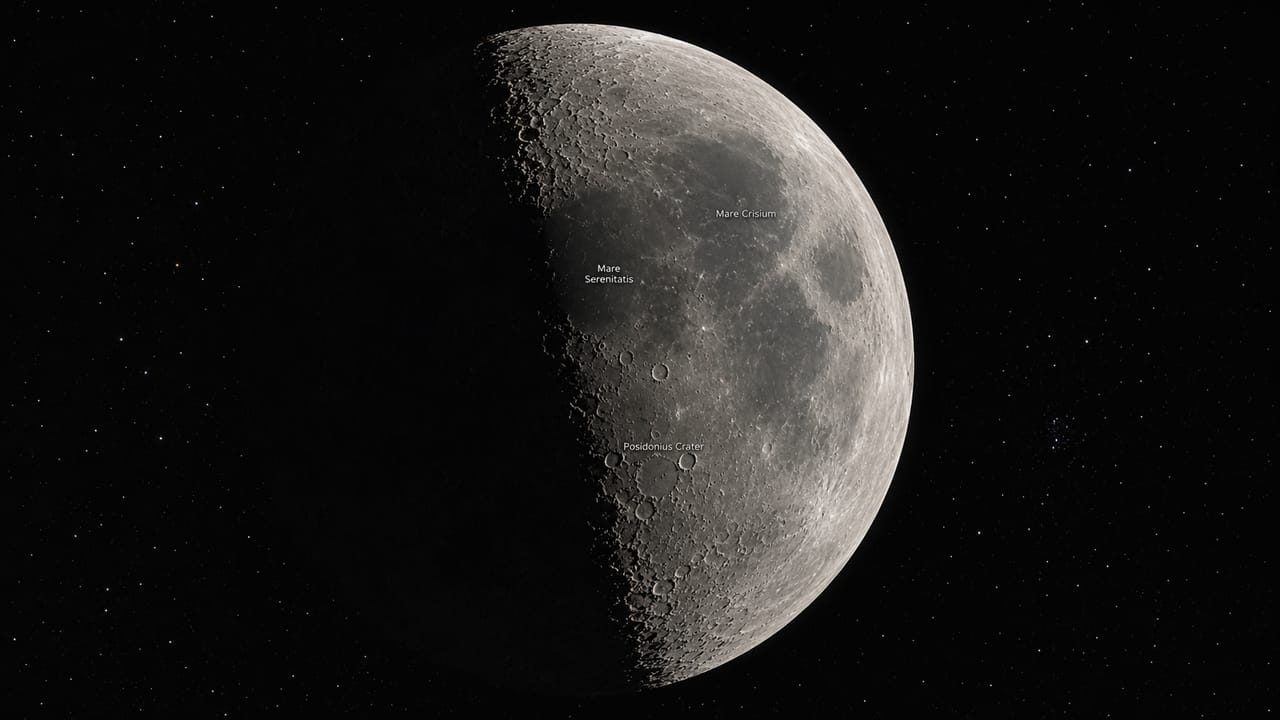 As the Moon progresses through its synodic cycle, its illuminated portion is growing larger each night, revealing a fascinating array of geological features that can be appreciated with the naked eye, binoculars, or a backyard telescope.
Whether you are an experienced astronomer or a curious beginner, this guide explains exactly what you need to know about tonight's lunar phase, the features you can spot, and how to understand the science of our closest celestial neighbor.
What is Today’s Moon Phase?
On Saturday, June 20, 2026, the Moon is in its Waxing Crescent phase. On this specific night, approximately 44% of the Moon's surface will be illuminated by the Sun, according to data from NASA's Daily Moon Guide.
Because it is at 44% illumination, the Moon is on the very cusp of its First Quarter phase (which occurs at exactly 50% illumination). The term "waxing" means that the illuminated portion is growing larger day by day, moving from the darkness of the New Moon toward the brilliant brilliance of the Full Moon. In the Northern Hemisphere, this illumination appears on the right side of the lunar disk, leaving a beautiful, bright curve hanging in the evening sky.
What Can You See Tonight? (Observation Guide)
A 44% illuminated Waxing Crescent is one of the absolute best phases for stargazing. Because the Sun hits the Moon at a sharp angle along the "terminator" (the line dividing the light and dark halves of the Moon), craters and mountain ranges cast long, dramatic shadows. This makes the topography pop with incredible contrast.
Here is what you can expect to spot on June 20, 2026, depending on the equipment you have on hand:
| Viewing Tool | Target Features | What to Look For |
|---|---|---|
| Naked Eye | Mare Fecunditatis, Mare Serenitatis, Mare Crisium | Large, dark basaltic plains formed by ancient volcanic activity on the Moon. They appear to the unaided eye as dark patches or "seas." |
| Binoculars | Endymion Crater, Posidonius Crater, Mare Nectaris | An impressive step up in detail. You will see distinct circular crater rims, central peaks, and the sharp boundaries of the Sea of Nectar. |
| Telescope | Apollo 17 Landing Spot, Descartes Highlands, Rupes Altai | High-magnification targets including the final human landing site of the Apollo program, rugged highland plains, and a dramatic, sweeping cliff-like escarpment. |
1. Naked Eye Targets: The Lunar Maria
Even without optical aid, you can see the distinct dark patches on the Moon known as maria (Latin for "seas"). On June 20, three prominent maria will be highly visible:
- Mare Crisium (Sea of Crises): A localized, dark, circular basin isolated from the other seas on the upper-right edge of the Moon.
- Mare Serenitatis (Sea of Serenity): A vast, circular basin located near the northern region of the illuminated side.
- Mare Fecunditatis (Sea of Fecundity): Situated in the lower-right quadrant, this basin has a somewhat irregular shape and rich geological history.
2. Binocular Targets: Striking Craters
Steadying a pair of binoculars against your brow will reveal stunning surface relief:
- Posidonius Crater: Located on the edge of Mare Serenitatis, this is a large, shallow crater with a complex, floor-fractured interior.
- Endymion Crater: Located near the northeastern limb, this crater features a dark, lava-flooded floor surrounded by a sharp, sunlit rim.
- Mare Nectaris (Sea of Nectar): A smaller basin that is beautifully highlighted under this specific angle of sunlight.
3. Telescope Targets: History and High Peaks
If you have a telescope, you can zoom in on deep space history and intense geological features:
- Apollo 17 Landing Site: Located in the Taurus-Littrow valley on the edge of Mare Serenitatis. This was the site of the last manned mission to the Moon in December 1972.
- Descartes Highlands: A rugged, highly reflective highland region famed for being the landing zone of Apollo 16.
- Rupes Altai (Altai Scarp): A spectacular mountain cliff or escarpment that stretches for hundreds of miles, casting a sharp shadow during this lunar phase.
Also Read: Relativity Space's NASA Mars Contract & 3D Rocket Quiz
The 8 Phases of the Lunar Cycle
The Moon takes approximately 29.5 days to complete a full orbit around Earth, a duration known as a synodic month. During this journey, the relative positions of the Earth, Moon, and Sun change, causing the Moon to progress through eight distinct, recognized phases.
| Phase Number | Phase Name | Description |
|---|---|---|
| 1 | New Moon | The Moon is positioned between the Earth and the Sun. The illuminated side faces away from us, making it invisible. |
| 2 | Waxing Crescent | A sliver of light appears on the right side (Northern Hemisphere) and grows daily. |
| 3 | First Quarter | Exactly half of the Moon's right side is illuminated. It looks like a perfect half-Moon. |
| 4 | Waxing Gibbous | More than half of the Moon is lit up, continuing to grow toward full illumination. |
| 5 | Full Moon | The entire near side of the Moon is illuminated by the Sun, shining brightly all night. |
| 6 | Waning Gibbous | The Moon begins to lose light on its right side as the illuminated portion shrinks. |
| 7 | Third (Last) Quarter | Exactly half of the Moon's left side is illuminated. |
| 8 | Waning Crescent | A thin sliver of light remains on the left side before disappearing back into a New Moon. |
Also Read: The Biology of Jumbo Phages: Ultimate Guide & Quiz
Looking Ahead: The Next Full Moon
If you enjoy the gentle, atmospheric glow of the Waxing Crescent, you will want to mark your calendar for the culmination of the current cycle. The next Full Moon will take place on June 29, 2026. On that night, the entire face of the Moon will be fully illuminated, reflecting maximum sunlight back to Earth and washing out fainter deep-sky objects, making the days leading up to it the perfect time to enjoy high-contrast crater viewing!
Test Your Space Knowledge: June 20 Moon Phase Quiz
Think you have mastered the details of tonight's moon phase and the lunar cycle? Challenge yourself with our 10-question multiple-choice quiz below!
Start Quizzes [MCQs]
REPORT CARD
ATTEMPTED QUESTIONS: 0CORRECT ANSWERS: 0
WRONG ANSWERS: 0
PRACTICE REGULARLY!
Frequently Asked Questions
What Moon phase is it on June 20, 2026?
On June 20, 2026, the Moon is in the Waxing Crescent phase, with about 44% of its surface illuminated by sunlight.
Can you see the Apollo 17 landing site on June 20, 2026?
Yes, if you use a telescope, you can locate the Taurus-Littrow valley where Apollo 17 landed near the edge of Mare Serenitatis.
When is the next Full Moon after June 20, 2026?
The next Full Moon of the cycle occurs on June 29, 2026, roughly nine days after the Waxing Crescent phase.