
This Week in Science: Groundbreaking Innovations Reshape Our Understanding
From restoring the power of speech to unlocking the secrets of the cosmos, this week in science has unveiled a cascade of breakthroughs that promise to redefine human capabilities and our perception of the natural world. Researchers have achieved monumental feats, including a voice-restoring brain implant, the advent of nuclear clocks, and fascinating insights into human behavior and ancient Earth history.
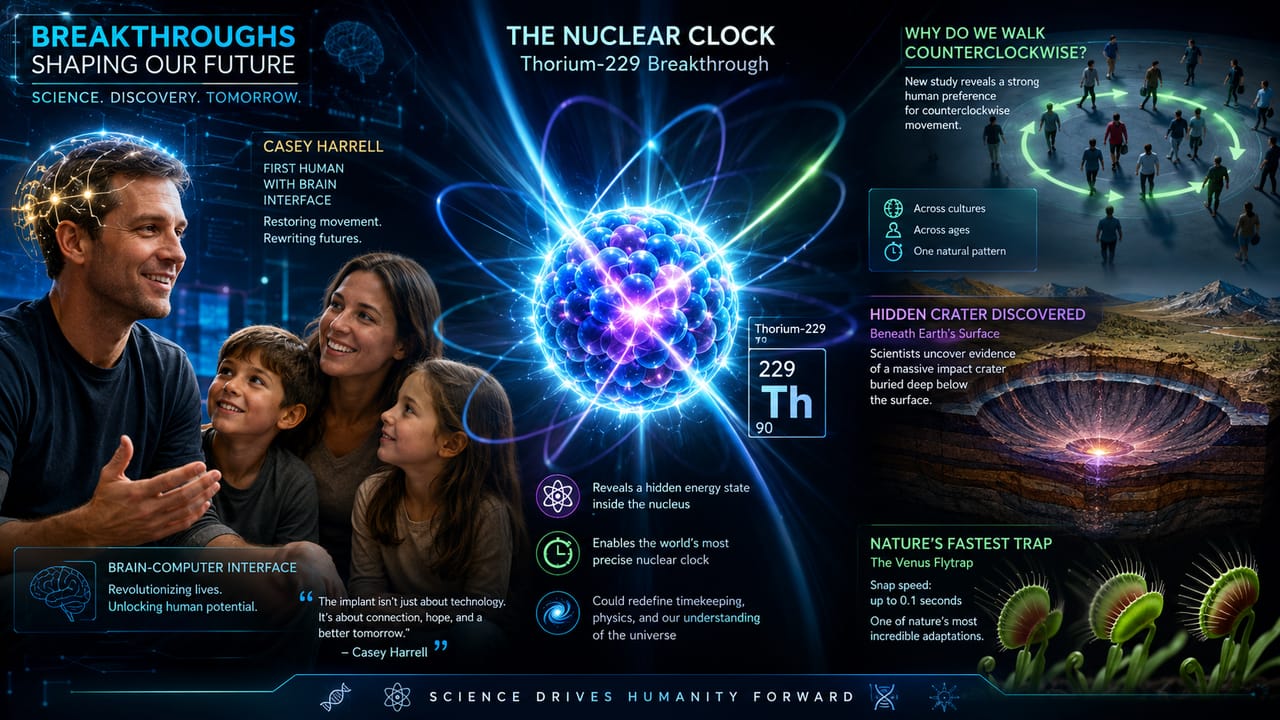
Join us as we delve into the most compelling scientific advancements that are pushing the boundaries of what we thought possible.
A New Voice: Brain Implant Restores Communication for ALS Patient
In a truly transformative medical development, a brain implant has enabled Casey Harrell, a man living with severe amyotrophic lateral sclerosis (ALS), to communicate fluently using a digital rendition of his own voice. ALS is a progressive neurodegenerative disease that affects nerve cells in the brain and spinal cord, leading to muscle weakness, paralysis, and eventually, the inability to speak, eat, move, and breathe. For individuals like Harrell, whose natural speech had become almost impossible to understand, this breakthrough offers a lifeline.
For nearly two years, Harrell has utilized a continuously operating brain-to-text decoder. This sophisticated system meticulously detects his brain activity when he attempts to form words, translating these neural signals into text. The latest advancement takes this a critical step further: verbalizing these thoughts through a digital voice meticulously crafted to sound like his own. The impact on his life has been profound, as he himself attests, enabling him to continue working and, crucially, to maintain deep connections with his wife, daughter, and loved ones.
Also Read: The Science of Strides: The Optimal Daily Walking Minutes After 50 to Prevent Sarcopenia
How the Brain-to-Text Decoder Works:
- Neural Signal Detection: Electrodes implanted in the brain detect specific patterns of neural activity associated with speech intent.
- Decoding Algorithm: Advanced algorithms interpret these neural signals, converting them into written text in real-time.
- Personalized Voice Synthesis: The decoded text is then fed into a voice synthesizer trained on recordings of the individual's original voice, producing natural-sounding speech.
- Continuous Communication: The system operates continuously, allowing for spontaneous and fluid expression of thoughts and feelings.
This technology represents a monumental leap forward, not just in assistive devices but in neuroprosthetics, offering hope to countless individuals whose voices have been silenced by debilitating conditions.
The Dawn of Nuclear Clocks: Unlocking New Realms of Precision
Humanity’s quest for ever-greater precision has taken a monumental step forward with the successful development of the world's first working nuclear clocks. For decades, atomic clocks have stood as the pinnacle of timekeeping, relying on the incredibly stable electron transitions within atoms to measure time with breathtaking accuracy. However, physicists have now ventured deeper, building clocks powered not by electrons, but by the subtle, yet powerful, changes within atomic nuclei.
This remarkable achievement, independently realized by two separate teams of scientists in Europe and China, utilizes the thorium-229 isotope. Unlike their atomic counterparts, nuclear clocks track energy shifts deep within the atom's nucleus. While these pioneering devices do not yet surpass the precision of the most advanced atomic clocks, their very existence validates a long-held theoretical dream and opens up unprecedented possibilities for future scientific endeavors.
Atomic vs. Nuclear Clocks: A Comparison
| Feature | Atomic Clocks | Nuclear Clocks (Thorium-229) |
|---|---|---|
| Mechanism | Tracks electron transitions outside the nucleus. | Tracks energy shifts within the atomic nucleus. |
| Current Precision | Extremely high; current gold standard for timekeeping. | Promising; not yet outperforming best atomic clocks, but rapidly advancing. |
| Vulnerability | Can be sensitive to external electromagnetic interference. | Potentially less vulnerable to external interference due to nuclear shielding. |
| Applications | GPS, telecommunications, fundamental physics experiments. | Investigating dark matter, searching for changes in fundamental constants, relativistic geodesy. |
| Development Status | Mature and widely deployed technology. | Nascent; first working prototypes successfully demonstrated. |
The inherent stability of nuclear transitions, largely shielded from external electromagnetic fields, suggests that nuclear clocks could eventually achieve even greater precision. This could lead to revolutionary applications in fields such as relativistic geodesy (measuring gravitational potential), fundamental physics, and potentially even detecting elusive dark matter.
The Unseen Bias in Our Steps: Humans Show a Global Walking Preference
Have you ever considered that your everyday walk might not be as random as you think? This week, scientists unveiled a surprising global pattern in human locomotion: a measurable, albeit modest, preference for turning counterclockwise. Across multiple independent experiments conducted in Spain and Japan, involving diverse settings and age groups, researchers consistently observed this statistically significant bias.
Engineer Claudio Feliciani described the finding as "completely unexpected." While a tendency to go left rather than right might seem like a mere quirk, its implications are far-reaching. Understanding this inherent bias could revolutionize the design of public spaces, making them more intuitive and efficient. It could also play a crucial role in crowd management strategies, particularly during emergency evacuations, potentially saving lives by anticipating movement patterns. The underlying cause of this fascinating bias remains a subject of ongoing investigation, with researchers exploring various hypotheses.
Also Read: 7 Fast Ways to Fix Brain Fog: Science-Backed 2026 Mental Reset
Hidden Treasure: Geologists Uncover a Rare Ancient Meteorite Impact Structure
Sometimes, the greatest discoveries come when you're searching for something else entirely. In Western Australia, geologists initially prospecting for gold unearthed a far rarer prize: unequivocal signs of an ancient and immensely powerful meteorite impact. Buried deep beneath the arid desert, the newly identified "Ora Banda" structure reveals evidence of an extraterrestrial collision potent enough to melt rock, deform crystals, and blast gold-bearing debris across the landscape.
What makes the Ora Banda structure particularly significant is its formation entirely within Archaean greenstone, some of Earth's most primordial rock formations. This makes it only the second confirmed impact structure of its kind. Given that the relentless forces of time and erosion often erase such impact scars, this discovery offers invaluable insights. It enhances our understanding of how to identify ancient collisions that leave almost no visible trace on the surface, helping scientists reconstruct Earth's tumultuous early history and the bombardment it endured.
Unveiling the Speed Secret of the Venus Flytrap
The Venus flytrap (Dionaea muscipula) has long captivated scientists and laypeople alike with its extraordinary ability to snap shut with astonishing speed, a feat typically uncharacteristic of the plant kingdom. This week, researchers have finally unravelled the ingenious biomechanical secret behind its rapid carnivorous action: a cunning manipulation of cell wall rigidity.
The key lies in the rapid softening of the cell walls within the trap's outer skin. This allows the outer surface to expand far more easily and quickly than the inner surface. As the outer cells swell, the leaf gradually bends until it reaches a critical tipping point, at which stage it instantaneously snaps closed, trapping unsuspecting insects or arachnids within milliseconds. This elegant biological mechanism not only offers inspiration for the design of novel soft, bio-inspired robotic devices but also prompts intriguing evolutionary questions about the development of such sophisticated rapid movement in plants.
New Horizons in Understanding Autism: Identification of Two Distinct Subtypes
Autism Spectrum Disorder (ASD) is renowned for its vast heterogeneity, presenting a broad range of characteristics and challenges that vary significantly from one individual to another. This complexity has long posed a hurdle for researchers striving to understand its underlying mechanisms and develop targeted interventions. However, a recent groundbreaking study, involving both human participants and mouse models, has identified a significant step forward: two distinct brain-based subtypes of the neurodevelopmental condition.
This discovery represents a crucial move away from a monolithic view of autism. The research identified the following:
Identified Autism Subtypes:
| Subtype Feature | Subtype 1 | Subtype 2 |
|---|---|---|
| Brain Connectivity | Reduced brain connectivity. | Increased brain connectivity. |
| Genetic Links | Genes involved in synaptic junctions (where brain cells communicate). | Immune-related genes. |
| Potential Implications | May inform interventions targeting neural communication pathways. | May suggest therapies related to neuroinflammation or immune system modulation. |
While these findings do not encompass the full spectrum of autism, they provide a powerful framework for future research. If these subtypes can be consistently confirmed and further characterized, they hold the potential to revolutionize diagnosis and treatment, paving the way for more personalized, effective interventions that move beyond a "one-size-fits-all" approach to autism care.
A Future Forged by Discovery
This week's scientific revelations underscore humanity's relentless pursuit of knowledge and innovation. From giving voice back to those who lost it and creating new paradigms in timekeeping to uncovering hidden patterns in our own biology and the Earth's ancient past, each discovery builds a stepping stone towards a more profound understanding of ourselves and the universe. These breakthroughs not only expand our scientific horizons but also promise tangible improvements in health, technology, and our collective future, inspiring further exploration and bold ideas.
Start Quizzes [MCQs]
REPORT CARD
ATTEMPTED QUESTIONS: 0CORRECT ANSWERS: 0
WRONG ANSWERS: 0
PRACTICE REGULARLY!