
As humanity prepares to return to the lunar surface under the Artemis program, the demand for advanced robotic scouts has never been more pressing. Traditional planetary rovers are notoriously slow, crawling across distant worlds at a snail's pace to avoid hazardous obstacles.
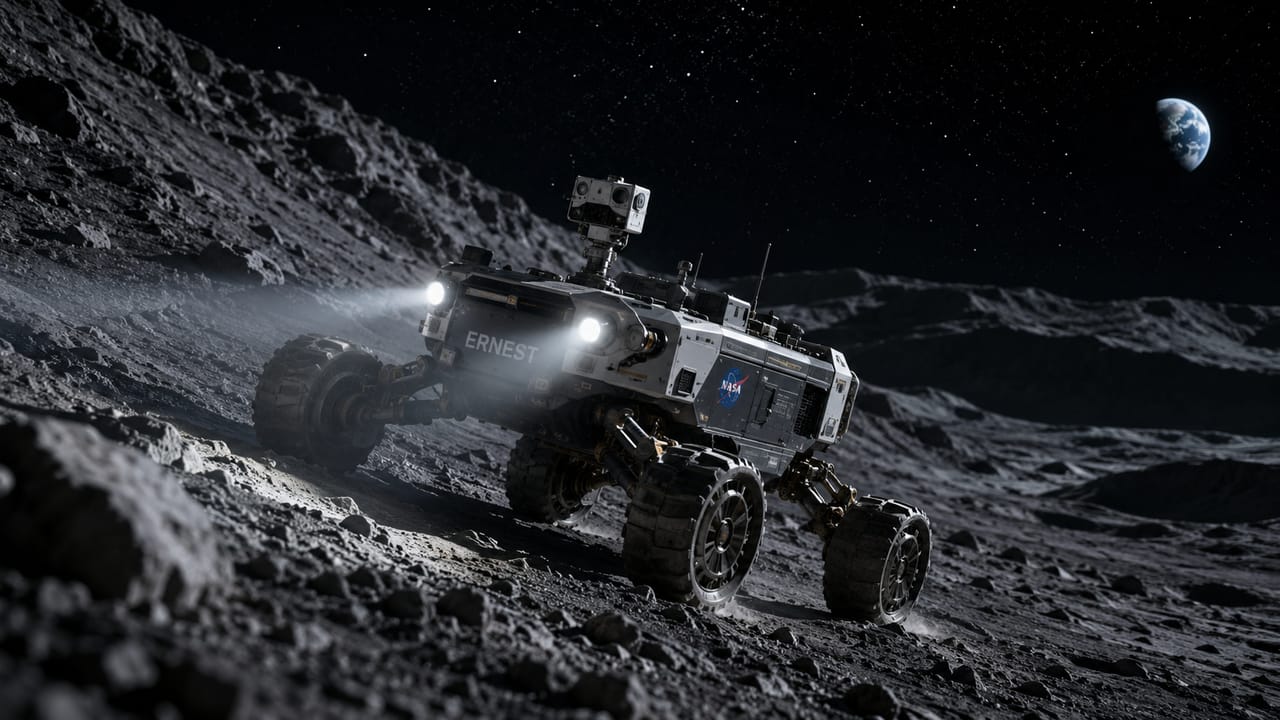
However, a revolutionary prototype developed by NASA’s Jet Propulsion Laboratory (JPL) is poised to rewrite the rules of extraterrestrial mobility. Meet Ernest—the Exploration Rover for Navigating Extreme Sloped Terrain—a four-wheeled powerhouse designed to navigate steep crater slopes and dark craters ten times faster than the famed Perseverance rover on Mars.
The Need for Speed and Agility on the Moon
To put Ernest's performance into perspective, it helps to understand why current rovers operate so slowly. On Mars, commands sent from Earth can take anywhere from 4 to 24 minutes to arrive, meaning rovers like Perseverance must crawl with extreme caution to prevent catastrophic, unrecoverable accidents. Perseverance averages speeds of less than 0.1 miles per hour. While this cautious approach has kept Mars missions safe for decades, future missions to the Moon’s polar regions cannot afford to move at a crawl.
The lunar South Pole is a primary target for upcoming human and robotic missions due to the presence of water ice trapped within permanently shadowed regions (PSRs). To find, analyze, and harvest this ice, rovers must descend into treacherous, pitch-black craters where temperatures plummet to near absolute zero. These missions require rapid, agile machines that can navigate autonomously before their solar panels lose light or their batteries succumb to the freeze. This is where Ernest steps in.
Also Read: Solar Wind Measurement Breakthrough & Space Weather Quiz
Comparing the Titans: Ernest vs. Perseverance
While Perseverance is a massive, car-sized mobile laboratory designed to search for ancient microbial life, Ernest is a streamlined testbed built specifically to master mobility, autonomy, and speed on vertical terrain.
| Feature | Ernest Rover (Prototype) | Perseverance Rover (Active Mars Mission) |
|---|---|---|
| Acronym Meaning | Exploration Rover for Navigating Extreme Sloped Terrain | Named to honor human persistence and curiosity |
| Primary Target | The Moon (Polar Regions, Crater Rims) | Mars (Jezero Crater) |
| Wheel Configuration | 4-Wheel High-Stability Drive | 6-Wheel Rocker-Bogie Suspension |
| Comparative Speed | Over 10 times faster than Perseverance | Up to 0.12 mph (0.2 km/h) max crawl |
| Primary Goal | Testing autonomy software on steep slopes and shadows | Astrobiology, sample collection, habitability testing |
| Developer / Funding | JPL / NASA's Mars Exploration Program | JPL / NASA Science Mission Directorate |
Also Read: Astronaut's Aurora View: A Space Spectacle
The Colorado Desert Trials: Conquering the Extreme
In March 2026, NASA engineers took Ernest out of the sterile lab environment and thrust it into the unforgiving landscape of the Colorado Desert, near Plaster City, California. This desert mimics the rocky, loose, and challenging terrain that a rover will face when scaling crater walls on the Moon.
During a grueling 37-hour endurance test, Ernest successfully traveled approximately 16 miles. The rover was not driven manually by joystick; instead, engineers tested its advanced autonomy software. This "computer brain" allows Ernest to scan the path ahead, identify hazards like boulders and steep drop-offs, and map out its own safe path forward in real time.
One of Ernest's defining physical attributes is its unique suspension system. When scaling rocky obstacles, the prototype is capable of maintaining high-traction ground contact even if one of its wheels is lifted high atop a jagged rock. This prevents the slippage that has trapped previous rovers in deep sand or rocky crevices.
Mastering the Shadows: Night Testing for Lunar Polar Exploration
Why did engineers run tests from dusk until dawn? The Moon's South Pole is characterized by low-angle sunlight, casting incredibly long, dramatic shadows. These shadows can completely obscure deep potholes, vertical drops, and loose regolith slopes. To standard optical navigation cameras, a shadow can look like an endless abyss or flat ground, leading to dangerous navigational errors.
To combat this, the engineering team outfitted Ernest with custom illuminators and advanced light-sensing hardware. By driving the rover in near-total darkness through the California desert, researchers trained Ernest’s artificial intelligence system to accurately interpret high-contrast, shadowed landscapes. This ensures that when Ernest eventually lands on the Moon, it won't be blinded by the dark.
Funding and Future Outlook
The journey of Ernest began in 2022, funded initially through internal Jet Propulsion Laboratory (JPL) development funds. Recognizing the critical importance of high-speed autonomy for future missions, NASA’s Mars Exploration Program eventually stepped in to back the project. While Ernest is currently a terrestrial prototype, the software and mobility concepts validated during these desert runs will serve as the blueprint for the next generation of lunar and Martian explorers.
Test Your Space Knowledge: Ernest Rover & Autonomy Quiz
Think you've mastered the details of NASA's speedy new rover? Take our 10-question multiple-choice quiz below to test your knowledge!
REPORT CARD
ATTEMPTED QUESTIONS: 0CORRECT ANSWERS: 0
WRONG ANSWERS: 0
PRACTICE REGULARLY!
Frequently Asked Questions
What is NASA's Ernest rover?
Ernest (Exploration Rover for Navigating Extreme Sloped Terrain) is a four-wheeled prototype rover developed by JPL to test autonomy software on steep slopes and low-light environments.
How fast can the Ernest rover travel?
Ernest is designed to travel more than 10 times faster than the Perseverance rover on Mars, which currently crawls at an extremely slow pace due to terrain hazards and communication latencies.
Why did NASA test the Ernest rover in the dark?
The Moon's polar regions have deep, long shadows that can confuse ordinary optical cameras. Testing Ernest from dusk till dawn helps train its computer vision and autonomy software to navigate in low-light and shadow-draped terrains.