
Unlocking the Sun's Secrets: A Universal Tool for Measuring Solar Wind and Forecasting Space Weather
The Sun, our life-giving star, constantly emits a torrent of charged particles known as the solar wind. This invisible outflow, traveling at immense speeds, is responsible for beautiful phenomena like the auroras but can also unleash powerful space weather events capable of crippling our technology-dependent world. For decades, scientists have strived for consistent and accurate methods to measure this solar wind, a crucial step in predicting its Earth-bound impacts.
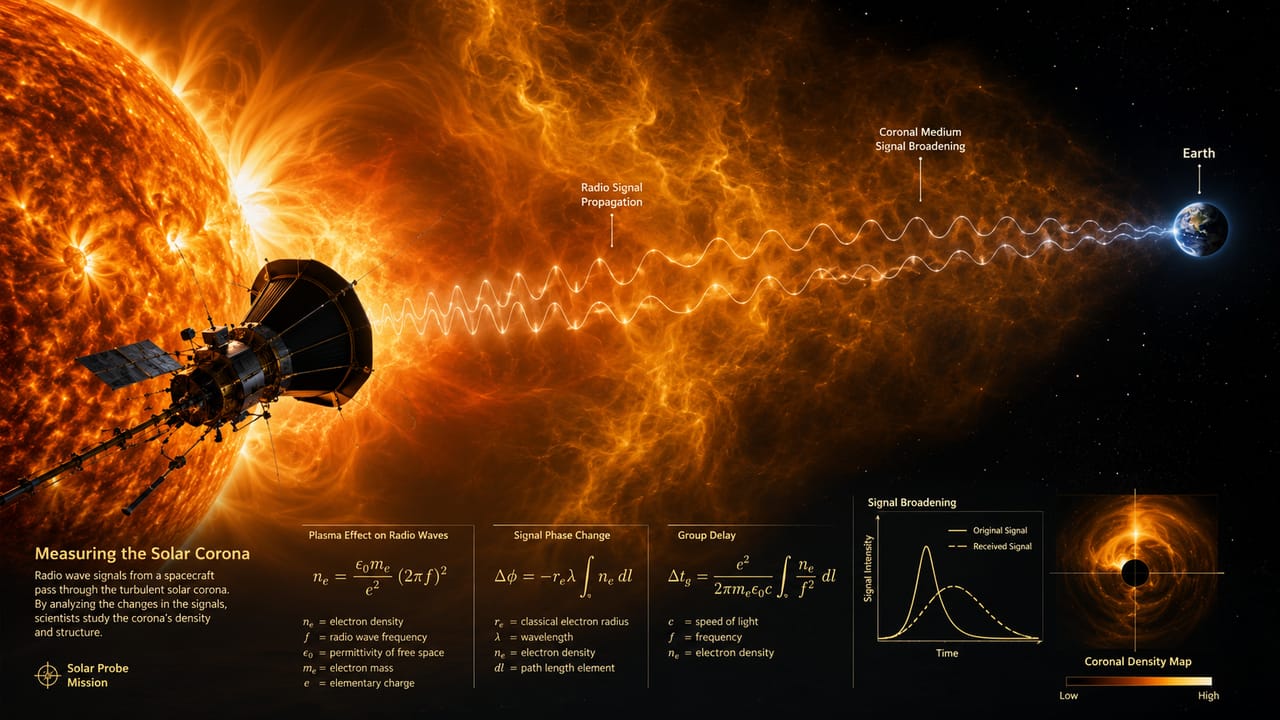
Now, an international team of researchers has unveiled a novel mathematical framework that promises to revolutionize this field, offering a universal approach to gauge the Sun's atmosphere using routine spacecraft radio signals.
Also Read: NASA's Roman Telescope: Unveiling the Universe's Secrets
The Elusive Solar Wind and Its Critical Impact
The solar wind originates from the Sun's outermost atmospheric layer, the corona – a superheated, chaotic plasma stretching millions of kilometers into space. This plasma, a fourth state of matter consisting of ionized gas, is a dynamic environment laced with complex magnetic fields. Understanding the speed and density of the solar wind is paramount because it directly drives space weather. When high-energy particles from severe solar storms collide with Earth's magnetosphere, they can cause significant disruptions:
| Target System | Potential Disruption | Real-world Consequence |
|---|---|---|
| Satellites (e.g., communication, GPS) | Radiation damage, orbital drag, signal interference | Loss of communication, inaccurate GPS navigation, satellite failure |
| Power Grids | Geomagnetically Induced Currents (GICs) | Massive power outages, transformer damage |
| Aviation | Disruption of high-frequency radio communication, increased radiation exposure for crew/passengers | Rerouting flights, safety concerns |
| Astronauts/Spacecraft | High radiation doses, damage to electronic components | Health risks, mission failure |
Previous methods for studying the solar corona and solar wind often faced limitations, particularly in their ability to provide consistent measurements across different space missions and radio frequencies.
A Universal Lens: Radio Occultation and Kolmogorov Turbulence
The new method hinges on an observational technique called radio occultation. This occurs when a spacecraft, from Earth's perspective, passes behind the Sun, causing its radio communication signals to traverse directly through the solar corona. As these radio waves interact with the turbulent coronal plasma, they undergo a phenomenon known as Doppler spectral broadening. Essentially, the signal gets distorted, scattered, and stretched, causing its frequency spectrum to widen. The extent of this widening provides crucial clues about the plasma's movement and density.
To translate these distorted radio signals into meaningful measurements, the research team, which includes experts from the Indian Institute of Technology (IIT) Indore, Vikram Sarabhai Space Centre (VSSC-ISRO), ISRO Telemetry Tracking and Command Network (ISTRAC), the University of Tokyo, and Kyoto Sangyo University, leveraged a foundational physics concept: Kolmogorov turbulence. Developed by Andrey Kolmogorov, this theory describes how energy in a turbulent fluid or plasma cascades from large, chaotic eddies down to much smaller scales. By assuming the Sun's coronal plasma follows this specific mathematical pattern, the researchers built a model that directly correlates the degree of radio signal distortion with the speed of the solar wind and the density of electrons in that region.
Overcoming Frequency Constraints: A Unified Framework
One of the most significant advancements of this new research lies in its ability to overcome a major hurdle that plagued earlier studies. Previously, mathematical tools used for radio occultation were severely constrained by the specific radio frequency employed. This meant that a formula designed for, say, India's Mars Orbiter Mission (MOM) would not accurately work for Japan's Venus Climate Orbiter, Akatsuki, which uses a different telecommunication band. Such frequency dependence made it exceedingly difficult to compare data consistently across various space missions.
The newly introduced frequency-scaled relation resolves this problem. It provides a single, unified mathematical framework that automatically adjusts for the radio signal's wavelength. This breakthrough allows scientists to seamlessly compare solar wind data from any spacecraft, irrespective of the radio frequency used for communication. This consistency is vital for building a comprehensive, long-term understanding of solar dynamics.
| Feature | Previous Methods (Radio Occultation) | New Mathematical Framework |
|---|---|---|
| Frequency Dependence | Highly dependent; formulas specific to certain radio frequencies | Frequency-scaled relation; automatically adjusts for different wavelengths |
| Data Comparability | Difficult to compare data across different missions due to frequency constraints | Seamless comparison of data from any spacecraft, regardless of frequency |
| Consistency of Measurement | Limited consistency across diverse observational setups | Enables consistent and routine measurement of solar wind speed and density |
| Applicability | Constrained to specific missions/frequencies | Universal applicability to any spacecraft's radio signal |
Also Read: Relativity Space's NASA Mars Contract & 3D Rocket Quiz
Assumptions and Future Refinements
While groundbreaking, the researchers acknowledge certain assumptions inherent in their generalized method. The model relies on the solar corona being perfectly spherical, the solar wind flowing in a steady outward direction, and the plasma strictly adhering to the Kolmogorov turbulence model. In reality, the Sun's atmosphere is far more complex and dynamic.
In regions near the Sun where the solar wind undergoes extreme and rapid acceleration, or where turbulence patterns are highly unpredictable, this simplified model's accuracy may diminish. Future models will need to incorporate these more intricate and evolving turbulence patterns to achieve even greater measurement precision. This ongoing refinement is a natural part of scientific progress, ensuring that our understanding of the Sun continues to evolve.
A New Era for Space Weather Prediction
The continuous outflow of charged particles from the Sun carries immense energy and magnetic flux through interplanetary space, directly influencing Earth's space environment. By maximizing the scientific utility of routine spacecraft radio signals, this innovative method paves the way for more frequent and consistent monitoring of the inner solar system. It offers a deeper understanding of how solar winds accelerate and behave, enabling earlier and more accurate predictions of extreme space weather events.
In an increasingly interconnected and technology-dependent world, safeguarding critical infrastructure – from GPS networks and satellite communications to power grids – is paramount. This new mathematical tool represents a significant leap forward, providing scientists with an enhanced capability to monitor, predict, and ultimately mitigate the risks posed by our dynamic star.
Solar Wind Measurement & Space Weather Quiz
REPORT CARD
ATTEMPTED QUESTIONS: 0CORRECT ANSWERS: 0
WRONG ANSWERS: 0
PRACTICE REGULARLY!