
China's AI System Revolutionizes Space Hurricane Tracking: A Deep Dive & Quiz
In a significant leap for space weather monitoring, a team of scientists led by China has successfully developed an advanced Artificial Intelligence (AI) system capable of automatically detecting and locating 'space hurricanes'. These unique atmospheric phenomena, occurring in Earth's upper atmosphere, pose a tangible threat to critical satellite signals, radar, and various radio communications.
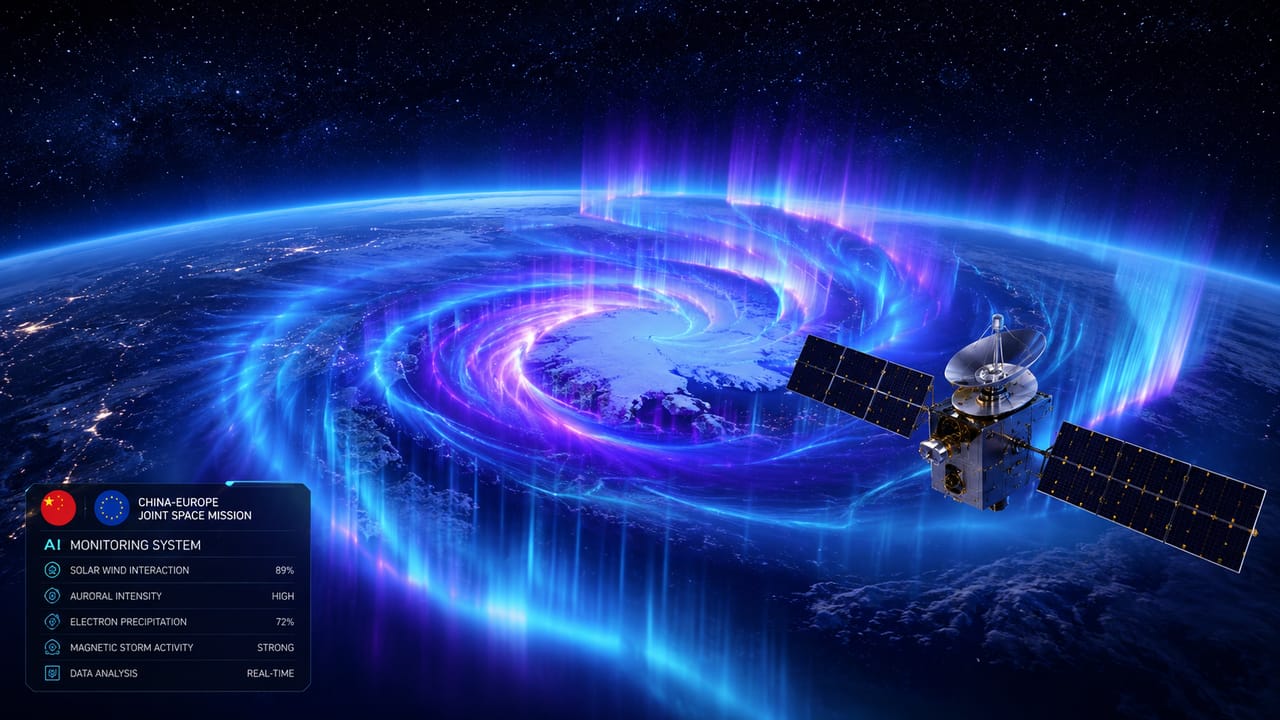
The new deep-learning system marks a pivotal shift from labor-intensive manual analysis to a highly efficient, automated approach, promising enhanced protection for our increasingly interconnected world.
Also Read: Science Breakthroughs & Innovations Quiz: This Week's Discoveries
Understanding Space Hurricanes: A Cosmic Enigma
Space hurricanes represent a fascinating, recently discovered facet of space weather. Unlike their terrestrial counterparts driven by warm ocean waters, these cosmic cyclones are immense, swirling auroral structures that manifest near Earth's magnetic poles. First directly observed in 2020 over the North Pole, they are essentially gigantic, funnel-shaped masses of plasma, several hundreds of kilometers wide, raining electrons into the ionosphere rather than water.
The term 'space hurricane' is a deliberate borrowing from the nomenclature of tropical cyclones, such as those found in the North Atlantic and northeastern Pacific, and typhoons in the northwestern Pacific. While sharing a similar spiral shape and rotational dynamics, their fundamental nature and impact mechanisms are vastly different.
The Mechanics Behind the Whirlwind
These majestic auroral swirls are formed when energy and particles from the solar wind are transferred into Earth's upper atmosphere and magnetic field, a process often linked to magnetic reconnection. The interaction creates electromagnetic forces that accelerate ionospheric plasma into a rotating, cyclonic structure, with electrons spiraling downwards and creating the visible aurora that gives the hurricane its signature appearance when viewed in ultraviolet light. This continuous rainfall of electrons generates significant currents and disrupts the delicate balance of the ionosphere.
Comparison: Space vs. Terrestrial Hurricanes
While sharing a name, space and Earthly hurricanes operate on entirely different principles and impact vastly different domains. Here's a brief comparison:
| Feature | Space Hurricanes | Terrestrial Hurricanes (e.g., Typhoons) |
|---|---|---|
| Formation Location | Earth's upper atmosphere (ionosphere), near magnetic poles | Warm ocean surfaces (troposphere) |
| Composition | Plasma (ionized gas, primarily electrons) | Water vapor, air |
| Energy Source | Solar wind, magnetic reconnection | Latent heat from condensing water vapor |
| Appearance | Swirling aurora, visible in UV light | Spiral cloud systems |
| Primary Impact | Disruption of satellite signals, radar, radio communications | Physical damage to infrastructure, flooding, strong winds |
| Detection Method | Ultraviolet imaging, magnetometers, AI systems | Satellite imagery (visible/IR), radar, weather stations |
The Chinese AI Breakthrough: Automating the Cosmic Watch
Previously, the detection and analysis of space hurricanes relied heavily on manual interpretation of satellite images, a time-consuming and often inconsistent process. The China-led team's innovation lies in its deep-learning AI system, which has been specifically trained to automatically identify and pinpoint these phenomena using ultraviolet images. UV imagery is crucial because it allows researchers to visualize the electron precipitation that forms the auroral 'eye' and swirling arms of a space hurricane, even when invisible to the naked eye.
How the AI Works
Deep learning, a subset of machine learning, involves training artificial neural networks on vast datasets to recognize complex patterns. In this context, the AI system has learned to distinguish the characteristic signatures of space hurricanes from other space weather events and background noise in UV images. This automation significantly reduces the time from observation to identification, enabling near real-time tracking.
| Feature | AI Detection System | Traditional Manual Detection |
|---|---|---|
| Speed | Near real-time processing | Slow, labor-intensive |
| Consistency | High, objective analysis | Variable, prone to human error/fatigue |
| Data Volume | Handles massive datasets continuously | Limited capacity for large-scale, continuous monitoring |
| Resource Intensity | High initial development, low operational cost | High continuous human resource requirement |
| Accuracy | High, after thorough training | Dependent on expert experience and vigilance |
Also Read: I Tested Gemini's New Compute Limits: Google AI Pro Update
Future Implications and Global Collaboration
The development of this AI system is not merely an academic triumph; it holds profound practical implications. The researchers anticipate that their newly developed AI system could be integrated to analyze data from a recently launched China-Europe satellite. Such collaboration underscores a growing international recognition of the need for shared data and advanced analytical tools in space weather prediction.
Improved detection and tracking capabilities are critical for mitigating the potential impact of space hurricanes. By providing early warnings, the AI system can help operators of vital infrastructure:
- Satellite Communications: Minimize disruptions to GPS, satellite internet, and television signals.
- Radar Systems: Ensure the reliability of aviation and defense radar.
- Radio Communications: Protect shortwave radio and other crucial communication channels.
The team's research, published in the peer-reviewed journal Space Weather, marks a significant step forward in humanity's understanding of these complex atmospheric phenomena and their far-reaching effects on our planet and technological infrastructure. As our reliance on space-based technology continues to grow, so too does the imperative to understand and predict the dynamic environment beyond Earth's protective lower atmosphere.
Quiz: Test Your Knowledge on Space Hurricanes!
REPORT CARD
ATTEMPTED QUESTIONS: 0CORRECT ANSWERS: 0
WRONG ANSWERS: 0
PRACTICE REGULARLY!
Frequently Asked Questions
What are space hurricanes?
Space hurricanes are recently discovered space weather phenomena that appear as huge, swirling auroral structures near Earth's magnetic poles. They are essentially funnel-shaped masses of plasma, hundreds of kilometers wide, that rain electrons into the ionosphere.
How do space hurricanes differ from Earthly hurricanes?
While both share a similar spiral shape, space hurricanes form in Earth's upper atmosphere (ionosphere) from plasma and solar wind energy, appearing as swirling auroras. Earthly hurricanes (tropical cyclones) form over warm oceans from water vapor and air. Their impacts also differ, with space hurricanes affecting satellite and radio communications, while Earthly hurricanes cause physical damage.
What is the main purpose of the Chinese AI system for space hurricanes?
The main purpose of the Chinese AI system is to automatically detect and precisely locate space hurricanes using ultraviolet images. This automates a process previously done manually, significantly improving efficiency and real-time monitoring.
How does the AI system detect space hurricanes?
The AI system is a deep-learning model trained to analyze ultraviolet (UV) images. UV light helps visualize the electron precipitation and auroral structures characteristic of space hurricanes, allowing the AI to identify and locate them efficiently.
What are the potential impacts of space hurricanes?
Space hurricanes can disrupt critical technological infrastructure, including satellite signals (such as GPS and internet), radar systems used for aviation and defense, and various forms of radio communications. Early detection is crucial to mitigate these potential impacts.