
Beyond the Singularity: Do Collapsing Stars Create Mini Universes?
For decades, the final fate of massive stars has seemed written in the cosmic stone of general relativity: when their fuel is spent, gravity wins, collapsing the stellar corpse into an infinitely dense point known as a singularity—a black hole. However, a groundbreaking theoretical study from Goethe University Frankfurt challenges this absolute destiny.
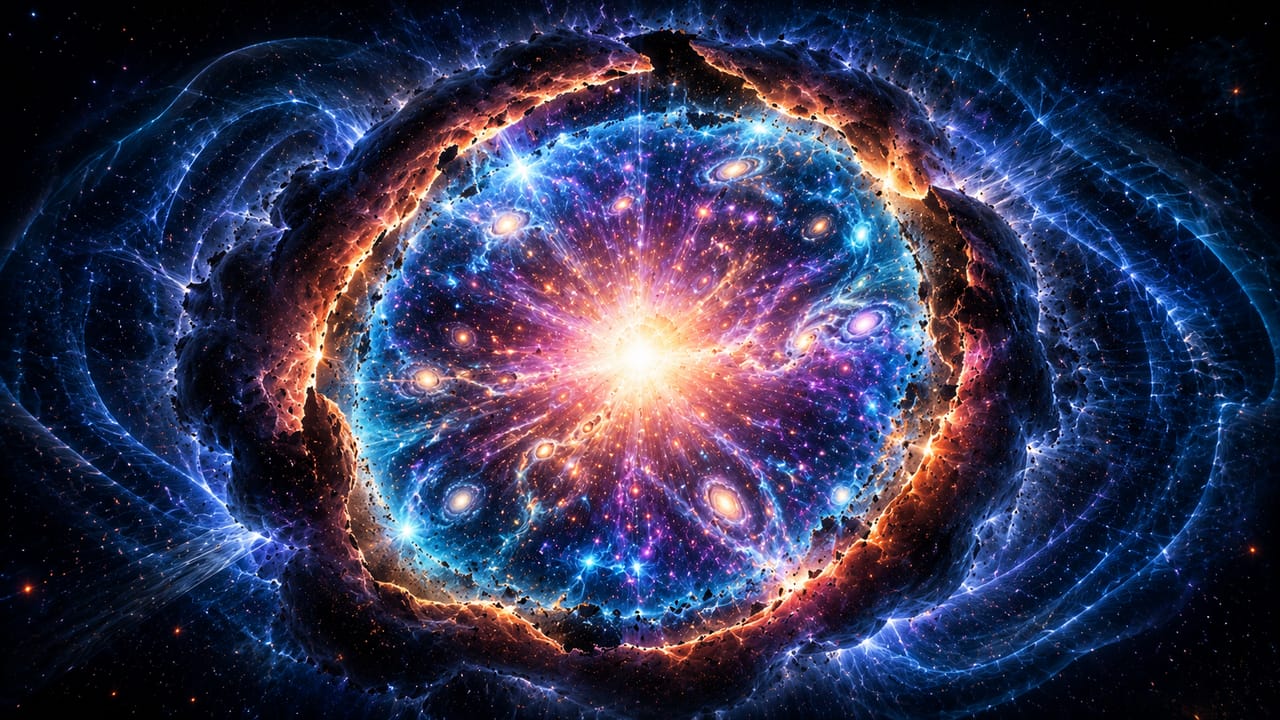
The study suggests that instead of forming an inescapable black hole, a collapsing massive star could trigger the birth of a baby universe deep within its core, resulting in a bizarre, stable object known as a gravastar.
Led by theoretical physicists Daniel Jampolski and Professor Luciano Rezzolla, this research introduces the first dynamic solution to Albert Einstein's equations of General Relativity that explains how such an exotic transformation could actually occur. If correct, this model could solve some of the deepest paradoxes in modern physics.
The Paradox of the Black Hole
To understand why physicists are searching for alternatives like gravastars, one must look at the mathematical limits of black holes. Under traditional models of stellar evolution, when a star containing dozens of solar masses runs out of nuclear fuel, its outward radiation pressure vanishes. Gravity pulls the matter inward with unstoppable force.
According to general relativity, this collapse continues until all mass is compressed into an infinitely small point with infinite density. This is the singularity. However, "infinite" density is a warning sign to physicists that their current mathematical equations have broken down. General relativity contradicts quantum mechanics at these extreme scales, leaving scientists without a reliable way to describe the physics occurring inside a black hole.
Furthermore, black holes are wrapped in an event horizon—a boundary from which nothing, not even light, can escape. This leads to the infamous black hole information paradox, where physical information about the matter that formed the black hole seems to disappear forever, violating the fundamental laws of quantum physics.
Also Read: NASA's Roman Telescope: Unveiling the Universe's Secrets
What is a Gravastar?
Proposed as an alternative in the early 2000s, a gravastar (Gravitational Vacuum Star) is an ultra-compact object that matches the mass and gravitational pull of a black hole but avoids its conceptual pitfalls. Instead of a singularity, a gravastar is filled with dark energy, a mysterious force that exerts an outward negative pressure.
In a gravastar, the outward push of dark energy perfectly balances the inward crush of gravity. Instead of an event horizon, it possesses a physical, ultra-dense shell of ordinary matter. To an outside observer, a gravastar would look almost identical to a black hole because of its extreme gravity, making them incredibly difficult to distinguish using current astronomical instruments.
Also Read: Titan: The Ultimate Space Outpost? NASA Scientist Explains
Comparing Black Holes and Gravastars
To better understand the differences between these two exotic cosmic objects, look at the technical breakdown below:
| Feature | Black Hole | Gravastar |
|---|---|---|
| Singularity | Yes (Infinitely dense point) | No (Smoothly distributed dark energy core) |
| Event Horizon | Yes (Point of no return) | No (Thin, physical shell of ultra-dense matter) |
| Core Interior | Unknown / Singular Point | Filled with Dark Energy (Vacuum energy) |
| Internal Pressure | None (Gravity wins completely) | Outward dark energy pressure counteracts gravity |
| Information Paradox | Yes (Information is trapped/lost) | No (No event horizon; info is theoretically retrievable) |
| Observational Difference | Extremely dark, curves spacetime | Virtually identical gravitational footprint to black holes |
A Dynamic Solution: The Birth of a Mini-Universe
While the concept of a gravastar has existed for roughly 25 years, scientists have long debated how one could actually form from ordinary matter. Daniel Jampolski and Professor Luciano Rezzolla solved this mystery by finding a dynamic solution to Einstein's equations.
According to their model, when a massive star collapses to near the point of becoming a black hole, the extreme density of the matter triggers a new physical phenomenon: a mini Big Bang. This localized Big Bang initiates the expansion of a tiny new universe inside the collapsing star.
Driven by dark energy, this baby universe expands outward, pushing back against the inward pull of gravity. The collapse is halted, and a stable, balanced gravastar is created. As Jampolski explains, "It is easier to imagine that the Big Bang occurs only at a very late stage, when matter has already been compressed to an extreme degree, thereby giving rise to new effects."
The Value of Scientific Skepticism
While this exotic alternative is captivating, Professor Luciano Rezzolla emphasizes that this research is not a rejection of traditional black holes. Black holes remain the simplest and most mathematically natural explanation for gravitational collapse, supported by observations from gravity wave detectors and the Event Horizon Telescope.
However, Rezzolla stresses that theoretical physicists must keep an open mind. "It is essential to maintain an unbiased approach towards what we do not know and hence explore both the accepted wisdom and the more exotic interpretations. History teaches us that it is not unusual for the latter to become the former," Rezzolla noted.
Test Your Knowledge: Gravastars vs. Black Holes Quiz
Think you've mastered the physics of gravastars and baby universes? Take our 10-question multiple-choice quiz below to find out!
REPORT CARD
ATTEMPTED QUESTIONS: 0CORRECT ANSWERS: 0
WRONG ANSWERS: 0
PRACTICE REGULARLY!
Frequently Asked Questions
What is a gravastar?
A gravastar (Gravitational Vacuum Star) is a theoretical ultra-compact object proposed as an alternative to black holes. It lacks a singularity and an event horizon, instead possessing a dense shell of ordinary matter and a core filled with dark energy.
How does a mini universe form inside a dying star?
According to a new study from Goethe University, during the late stages of a massive star's collapse, the extreme compression of matter triggers a localized Big Bang. This creates an expanding mini-universe inside, driven by dark energy, which halts the gravitational collapse.
Why do physicists want an alternative to black holes?
Black holes present serious physical paradoxes. They require matter to compress into an infinitely dense point (singularity) where the known laws of physics break down, and their event horizons create the information paradox, where physical information seems to be lost forever.