
Introduction: The Dawn of Symbiotic Computing
For decades, human interaction with digital systems has been defined by translation. We translate our thoughts into finger taps on a keyboard, hand gestures on a mouse, or spoken words directed at a voice assistant. This process is inherently bottlenecked; it forces the human brain to adapt to the rigid, binary logic of silicon. However, a quiet revolution is taking place in neurotechnology.
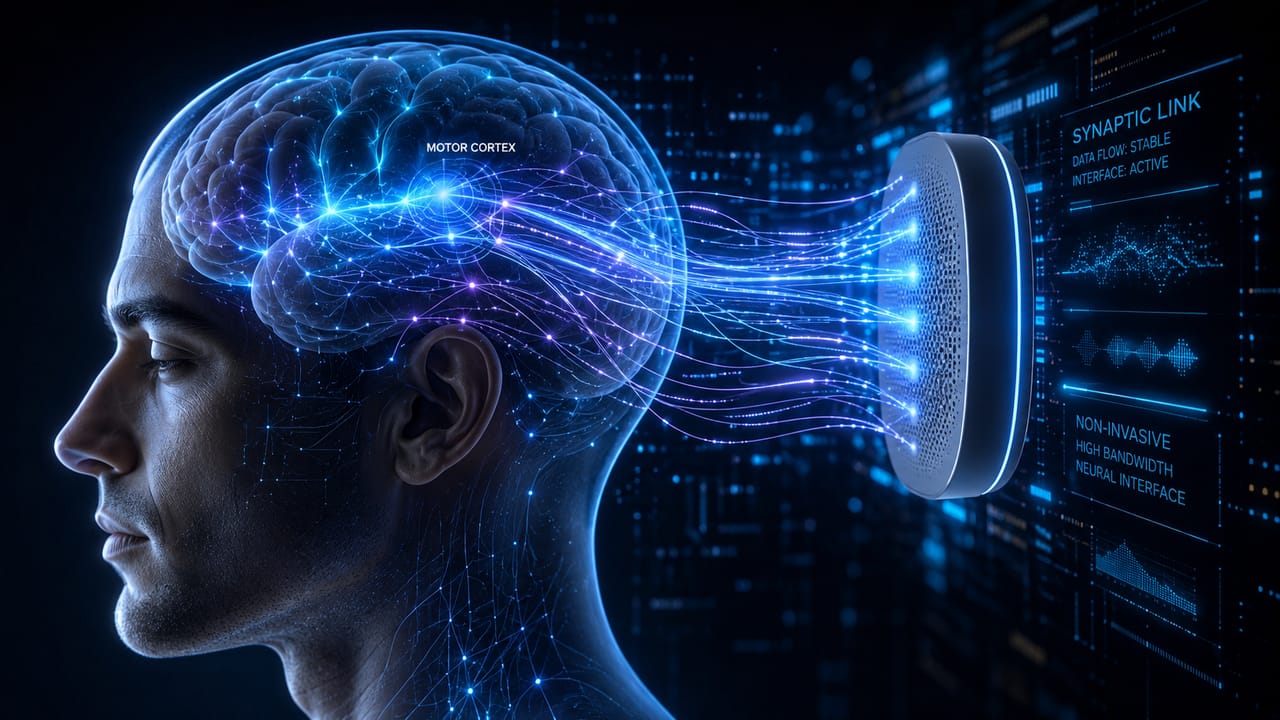
The latest frontier of Brain-Computer Interfaces (BCIs) is moving away from forcing the user to adapt to the computer. Instead, engineers and neuroscientists are developing systems that work with, not against, the natural architecture of the human brain.
By mimicking biological learning, leveraging advanced machine learning, and utilizing adaptive closed-loop systems, the next generation of BCIs promises a seamless integration where the line between human intention and computer execution is virtually erased.
The Paradigm Shift: Intuitive vs. Forced Adaptation
Early BCI systems required monumental effort from users. In classic electroencephalography (EEG) setups, a user might have to concentrate intensely on a specific, unnatural mental task—such as imagining a rotating cube—just to move a cursor slightly to the left. This forced adaptation causes cognitive fatigue and limits the practical utility of the interface.
Modern symbiotic BCIs flip this dynamic. By utilizing advanced decoding algorithms powered by deep learning, these systems learn the unique, natural neural signatures of the user. If a user wants to move a prosthetic hand, they simply think about grasping an object in the same natural way they always have. The BCI monitors the motor cortex, recognizes these highly individualized neural patterns, and translates them into physical movement without requiring the user to learn a new "mental language."
Also Read: Rewire Your Brain: The Ultimate Science-Backed Guide to Laser Focus
Comparing Brain-Computer Interface Modalities
To understand how these interfaces achieve harmony with the brain, it is essential to examine the different ways we can access neural signals. Each modality offers a different trade-off between signal quality and surgical risk.
| Modality | Invasiveness | Signal Resolution | Primary Advantages | Key Challenges |
|---|---|---|---|---|
| Non-Invasive (e.g., EEG, fNIRS) | None (Sits on scalp) | Low (Signals scattered by skull) | Completely safe, easy to set up, highly portable. | Low signal-to-noise ratio, highly susceptible to muscle movement artifacts. |
| Semi-Invasive (e.g., ECoG) | Medium (Placed on brain surface) | Medium-High | Better signal resolution than EEG, lower infection risk than deep implants. | Requires craniotomy, long-term stability of signals is still being researched. |
| Invasive (e.g., Microelectrode Arrays) | High (Penetrates brain tissue) | Very High (Single-neuron resolution) | Unmatched precision, ideal for complex robotic limb control. | High surgical risk, tissue scarring (gliosis) can degrade signal over time. |
How a Symbiotic BCI Works: The Closed-Loop System
A computer interface that truly works with the brain cannot be a one-way street. It must operate as a closed-loop system, creating an ongoing dialogue between biological neurons and artificial algorithms.
1. High-Fidelity Signal Acquisition
Whether using non-invasive EEG caps or implanted microelectrode arrays, the system continuously monitors electrical activity. By targeting specific brain regions, such as the motor cortex for movement or the visual cortex for perception, the interface captures raw data containing the user’s intent.
2. Adaptive Neural Decoding
This is where machine learning plays a vital role. Raw neural signals are incredibly noisy and fluctuate depending on factors like attention, fatigue, and neuroplasticity. Advanced neural decoders use deep neural networks to isolate relevant patterns from background noise, adapting in real-time to the user's changing brain state.
3. Sensory Feedback
For a BCI to feel like a natural extension of the body, feedback is essential. If a paralyzed patient uses a robotic arm to grip a cup, sensors on the robotic fingers send electrical stimulation back to the sensory cortex of the brain. The brain receives a natural-feeling tactile sensation, allowing it to modulate its control signals instantly, creating a harmonious control loop.
Also Read: 10 mind blowing ai tools you must try in 2026
The Technical and Ethical Hurdles Ahead
While the potential of symbiotic BCIs is staggering, several roadblocks remain before widespread adoption is possible:
- Biocompatibility: The brain is a hostile environment for foreign objects. Implanted electrodes must be engineered from flexible, bio-inert materials to prevent the body's immune system from encapsulating them in scar tissue.
- Neural Plasticity: The human brain is constantly rewiring itself. A decoding algorithm that works perfectly today may fail tomorrow as the user's neural pathways adapt. BCIs must feature continuous, background self-calibration.
- Cognitive Liberty & Privacy: Interfaces that read neural intent present unique ethical dilemmas. Protecting "brain data" from unauthorized access, commercial exploitation, or manipulation is paramount.
Interactive Practice: Test Your Knowledge
Now that you have explored how modern brain-computer interfaces work with the brain, test your understanding with the interactive quiz below.
Start Quizzes [MCQs]
REPORT CARD
ATTEMPTED QUESTIONS: 0CORRECT ANSWERS: 0
WRONG ANSWERS: 0
PRACTICE REGULARLY!
Frequently Asked Questions
What does a BCI that works 'with' the brain mean?
It refers to an interface that uses machine learning to decode the natural intentions of the user, adapting to the brain's existing pathways instead of forcing the user to train exhaustively to produce artificial mental states.
How does a closed-loop BCI system work?
A closed-loop system records neural activity, decodes the intention, performs the corresponding mechanical or digital action, and feeds tactile or visual information back to the brain, establishing a natural feedback circle.
What are the primary hurdles to long-term BCI implants?
The main challenges are biocompatibility (avoiding glial scarring), dealing with the brain's natural neuroplasticity that alters signals over time, and securing data privacy for sensitive brain patterns.