
Moon Phase Today: A Glimpse at the Waxing Gibbous on June 22nd, 2026
June 22nd, 2026, skygazers are treated to the captivating sight of a Waxing Gibbous Moon. As our celestial neighbor steadily progresses towards its magnificent full illumination, each night offers a subtly brighter and more pronounced view.
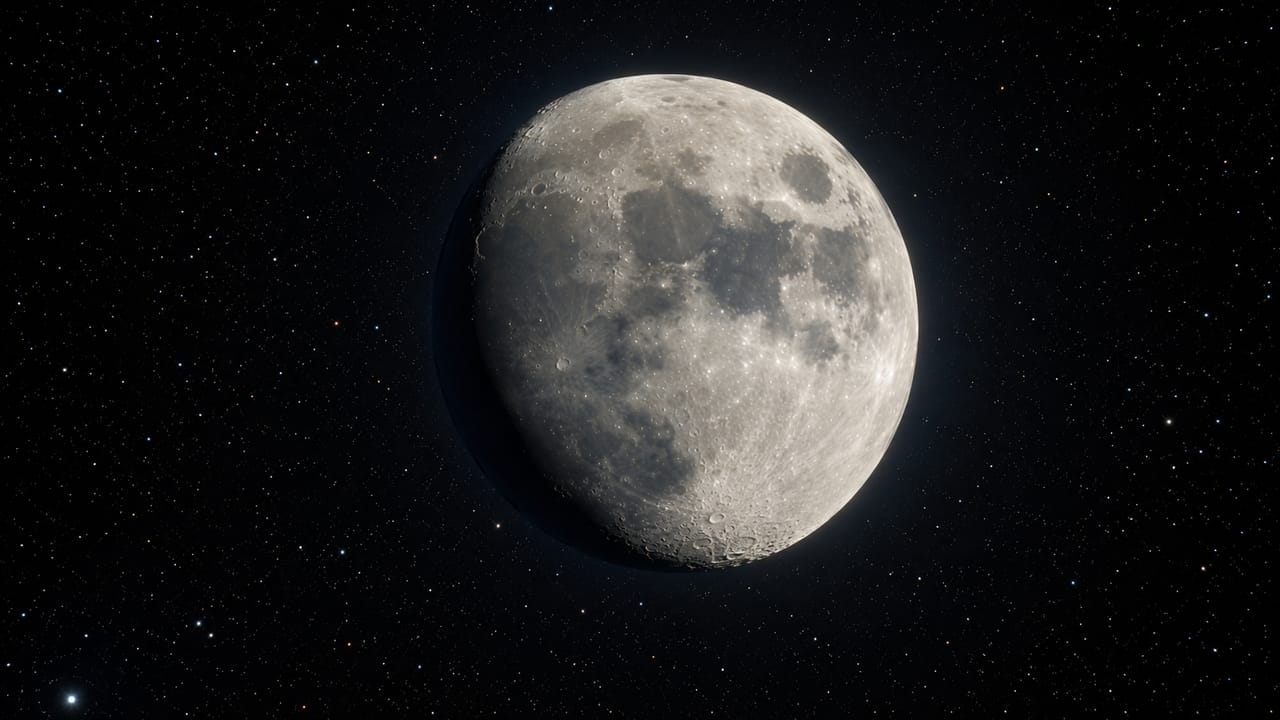
Following the First Quarter, the Moon is now significantly more than half illuminated, a testament to its continuous dance around Earth and the ever-changing angle of sunlight it reflects.
The Current Lunar Stage: Waxing Gibbous
As of Sunday, June 21st, and continuing into Monday, June 22nd, the Moon is firmly in its Waxing Gibbous phase. This means that more than half of its visible surface is illuminated, and this illuminated portion is growing larger each night as it "waxes" towards fullness. According to NASA's Daily Moon Guide, tonight, approximately 64% of the Moon's face will be bathed in sunlight, offering a splendid view for observers across the globe.
Also Read: NASA's Roman Telescope: Unveiling the Universe's Secrets
What to Look For: A Guide to Lunar Observation
Even with the naked eye, the Moon reveals incredible detail. With simple optical aids like binoculars or a telescope, the lunar landscape truly comes alive, showcasing a rugged beauty sculpted by billions of years of cosmic impacts.
| Observation Tool | Visible Features (June 22nd) | Description |
|---|---|---|
| Naked Eye | Mares Fecunditatis, Serenitatis, Tranquillitatis | These vast, dark plains are ancient basaltic basaltic lava flows, easily discernible as the "man in the moon" features. Fecunditatis (Sea of Fecundity), Serenitatis (Sea of Serenity), and Tranquillitatis (Sea of Tranquility, where Apollo 11 landed) are prominent. |
| Binoculars (e.g., 10x50) | Archimedes Crater, Posidonius Crater, Mare Nectaris (in addition to naked-eye features) | Binoculars bring craters into sharper relief. Archimedes is a large, lava-flooded impact crater. Posidonius is an ancient, large lunar impact crater. Mare Nectaris (Sea of Nectar) is a smaller, round mare with a distinct appearance. |
| Telescope | Caucasus Mountains, Descartes Highlands, Rima Hyginus (in addition to all above) | A telescope unveils finer details. The Caucasus Mountains are a rugged range. The Descartes Highlands are a highly cratered area. Rima Hyginus is a fascinating linear rille, believed to be a collapsed lava tube or fault line. |
The Countdown to Fullness: When is the Next Full Moon?
The Moon's journey from a slender crescent to a luminous orb is a fascinating spectacle. From its current Waxing Gibbous phase, it will continue to grow brighter and fuller each evening. The next Full Moon is anticipated to grace our skies on June 29th, 2026. This is when the Moon will be directly opposite the Sun in Earth's sky, presenting its entire sunlit face to us, a breathtaking display of cosmic alignment.
Also Read: Nasa's Ernest Rover: A Lunar Speedster Meets Its Match
Demystifying the Lunar Cycle: Understanding Moon Phases
The ever-changing appearance of the Moon, known as its phases, is one of the most familiar and captivating celestial phenomena. Far from actually changing shape, the Moon's visible form alters due to its orbit around Earth and the varying angles at which we observe the portion of its surface illuminated by the Sun.
According to NASA, the Moon completes one full orbit around Earth in approximately 29.5 days. During this synodic month, it cycles through eight distinct and recognizable phases, collectively known as the lunar cycle. While the same side of the Moon always faces our planet (due to tidal locking), the amount of its surface lit by the Sun changes, creating the different shapes we perceive.
The Eight Phases of the Moon Explained
Let's delve into each phase of this incredible celestial ballet:
| Moon Phase | Description | Visibility (Northern Hemisphere) |
|---|---|---|
| New Moon | The Moon is positioned between Earth and the Sun. The side facing Earth is completely dark, making it invisible to the naked eye. This marks the beginning of a new lunar cycle. | Invisible |
| Waxing Crescent | A small sliver of light appears on the right-hand side of the Moon. The illuminated portion grows larger each night. | Visible after sunset, a thin crescent. |
| First Quarter | Exactly half of the Moon's visible face is illuminated on the right side. It appears as a perfect "half-moon." | Visible in the afternoon and early evening. |
| Waxing Gibbous | More than half of the Moon is lit up, but it's not yet full. The illuminated portion continues to grow. This is the phase we are currently observing on June 22nd. | Visible from late afternoon through most of the night. |
| Full Moon | The entire face of the Moon visible from Earth is fully illuminated. It appears as a bright, complete circle. | Visible all night, rising around sunset. |
| Waning Gibbous | The Moon begins to lose light on its right side. More than half is still illuminated, but the lit portion is now shrinking. | Visible from late evening through morning. |
| Third Quarter (or Last Quarter) | Exactly half of the Moon's visible face is illuminated, but now on the left side. It again appears as a "half-moon." | Visible in the late night and morning. |
| Waning Crescent | A thin sliver of light remains on the left side, continuing to shrink until it becomes completely dark again at the New Moon. | Visible just before sunrise. |
Beyond the Phases: Cultural Significance and Observation Tips
Throughout history, the Moon's phases have played a crucial role in human societies, influencing everything from ancient calendars and agricultural practices to religious festivals and folklore. Its predictable cycle provided a rhythm to life before modern timekeeping.
For optimal Moon gazing:
- Find a dark spot: Minimize light pollution for the best views.
- Use an app: Many astronomy apps can show you the Moon's exact position and phase in real-time.
- Patience is key: Take your time to let your eyes adjust to the darkness.
- Dress appropriately: Even summer nights can get cool.
The Moon continues to be a source of wonder and scientific discovery, constantly inspiring us to look up and ponder our place in the cosmos. Enjoy the Waxing Gibbous phase on June 22nd, and anticipate the splendor of the upcoming Full Moon!
Moon Phase Quiz: Test Your Knowledge!
How well do you know our celestial neighbor? Answer these multiple-choice questions based on the article.
REPORT CARD
ATTEMPTED QUESTIONS: 0CORRECT ANSWERS: 0
WRONG ANSWERS: 0
PRACTICE REGULARLY!
Frequently Asked Questions
What is a Waxing Gibbous moon?
A Waxing Gibbous moon is when more than half of the Moon's visible surface is illuminated, and the illuminated portion is growing larger each night as it heads towards the Full Moon.
How often does a Full Moon occur?
A Full Moon occurs once during each lunar cycle, which is approximately every 29.5 days, when the entire face of the Moon visible from Earth is fully illuminated by the Sun.
What causes the Moon phases?
The Moon phases are caused by the Moon's orbit around Earth and the varying angles at which we observe the portion of its surface illuminated by the Sun. As the Moon moves, we see different amounts of its sunlit side.