
The Galactic Center Excess: A Decade-Long Cosmic Conundrum
For over ten years, astrophysicists have been captivated and puzzled by a strange phenomenon occurring at the very heart of our galaxy. Known as the Galactic Center Excess (GCE), this anomaly manifests as a spherical, high-energy glow of gamma rays emanating thousands of light-years from the core of the Milky Way.
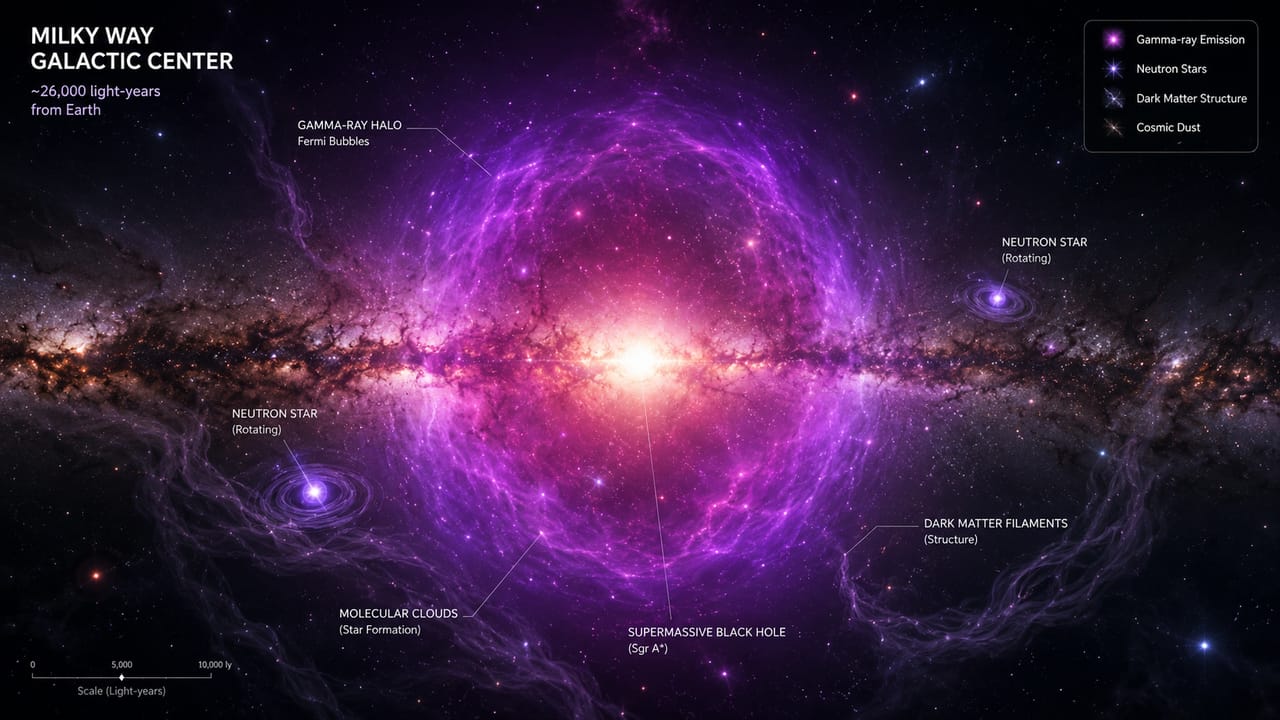
Discovered using data from NASA's Fermi Gamma-ray Space Telescope, this glow has sparked one of the longest-running debates in modern astrophysics: What is causing this surplus of high-energy radiation?
While several theories have been proposed, the debate has largely narrowed down to two primary contenders: a dense, unresolved population of ancient, rapidly spinning stars called pulsars, or the elusive, self-annihilating particles of dark matter.
Also Read: NASA's Roman Telescope: Unveiling the Universe's Secrets
The Dual Hypotheses: Dark Matter vs. Stellar Remnants
To understand why this emission is so controversial, it is helpful to look at the two leading explanations side-by-side. Both models can theoretically explain the shape and energy spectrum of the observed gamma rays, yet they point to fundamentally different realities about our universe.
| Feature | Dark Matter Annihilation Hypothesis | Millisecond Pulsar (MSP) Hypothesis |
|---|---|---|
| Proposed Mechanism | Dark matter particles (WIMPs) collide, self-annihilate, and emit high-energy gamma rays. | A dense population of rapidly spinning neutron stars (pulsars) emit beam radiation. |
| Spatial Distribution | Spherical, smooth, extending thousands of light-years from the galactic core. | Concentrated along the galactic plane and bulging at the stellar core. |
| New Study Findings | Highly plausible; the smooth emission signature closely matches predictions. | Requires >35,000 highly faint pulsars, making them nearly indistinguishable from dark matter. |
| Verification Status | Unproven; dark matter remains direct-detection-elusive. | Unproven; individual faint pulsars are currently too dim to resolve. |
The Dark Matter Candidate
Dark matter accounts for roughly 85% of all matter in the universe, yet it remains completely invisible to our instruments because it does not interact with light or electromagnetic forces. However, many theoretical models suggest that dark matter particles could be their own antiparticles. In dense regions—such as the core of a galaxy—these particles would occasionally collide and annihilate each other, releasing bursts of pure energy in the form of gamma rays.
The Pulsar Alternative
On the other hand, pulsars—highly magnetized, rotating neutron stars—are known emitters of gamma rays. If the Milky Way's core houses tens of thousands of these dead stellar remnants, their combined, unresolved light could easily mimic the smooth, spherical glow that we observe as the Galactic Center Excess.
Also Read: Could Dying Stars Birth New Universes?
How Machine Learning Is Breaking the Deadlock
Studying the center of our galaxy is incredibly challenging. As Florian List, a researcher from the University of Vienna, explains: "Interpreting the signal is particularly difficult because the Galactic Center is an exceptionally bright and crowded region of the gamma-ray sky." The gas, dust, and millions of stars in the region create a massive background "noise" that makes it hard to isolate the excess signal.
To overcome these hurdles, List and an international team of researchers utilized advanced machine learning models. The team trained their neural networks on over a million simulated gamma-ray observations of the galactic center to see if artificial intelligence could differentiate between the smooth glow of dark matter and the point-like, pixelated signature of thousands of faint pulsars.
The results of the study, co-authored by researcher Nick Rodd, were eye-opening. The neural network revealed that if pulsars are indeed responsible for the excess, they would have to be incredibly faint—far fainter than previously estimated. In fact, to generate the observed glow, the core would need to host more than 35,000 pulsars.
Because these proposed pulsars would be so exceptionally dim, their collective emission signature would be virtually indistinguishable from the smooth, continuous glow expected from self-annihilating dark matter.
What Lies Ahead?
While this research keeps the dark matter hypothesis firmly on the table, the team is quick to point out that they have not officially proven its existence. "Our work does not show that dark matter is responsible for the signal," List noted. "However, it suggests that it is still too early to rule out this possibility."
Future telescopes with higher angular resolution, such as the Cherenkov Telescope Array (CTA), may eventually possess the power to resolve these incredibly faint individual sources, finally solving one of the cosmos' most enduring mysteries.
Test Your Knowledge: Milky Way's Gamma Ray Mystery Quiz
Think you have mastered the science behind the Galactic Center Excess? Challenge yourself with our 10-question astrophysics quiz below!
REPORT CARD
ATTEMPTED QUESTIONS: 0CORRECT ANSWERS: 0
WRONG ANSWERS: 0
PRACTICE REGULARLY!
Frequently Asked Questions
What is the Galactic Center Excess (GCE)?
The Galactic Center Excess (GCE) is an unexplained spherical glow of high-energy gamma rays emanating from the core of the Milky Way galaxy, extending thousands of light-years outward.
Why are gamma rays difficult to study at the Milky Way's core?
The Galactic Center is an exceptionally bright, crowded region packed with dust, gas, and millions of stars, which creates intense background noise that obscures faint signals.
Can dark matter explain the Milky Way's gamma rays?
Yes. If dark matter particles are their own antiparticles, they would occasionally collide and annihilate each other in the dense galactic core, releasing energy as gamma rays. Recent studies suggest this hypothesis remains highly plausible.
How many pulsars would be needed to explain this phenomenon?
According to machine learning models, it would require a population of over 35,000 extremely faint pulsars at the Milky Way's core to match the observed gamma-ray glow.