
The AI Revolution in Animal Behavior Research
In the intricate world of behavioral ecology, understanding the subtle interactions between species has traditionally been a labor-intensive endeavor, often relying on painstaking manual observation and annotation of video footage. However, a recent Nature preprint, published on June 3, 2026, signals a significant leap forward, demonstrating how ai is changing daily life and transforming this field. Researchers have developed a semi-automated system that accurately detects fish cleaning interactions, promising to drastically accelerate the pace of ethological studies.
This breakthrough, highlighted by Let's Data Science, utilizes cutting-edge deep learning techniques, specifically markerless pose estimation via DeepLabCut, combined with a sophisticated classification algorithm. The result is a system that not only offers high detection accuracy but also substantially reduces the burden of manual data annotation, freeing up researchers to focus on deeper analysis.
Unveiling the Symbiosis: Cleaner Wrasse and Powder Blue Tang
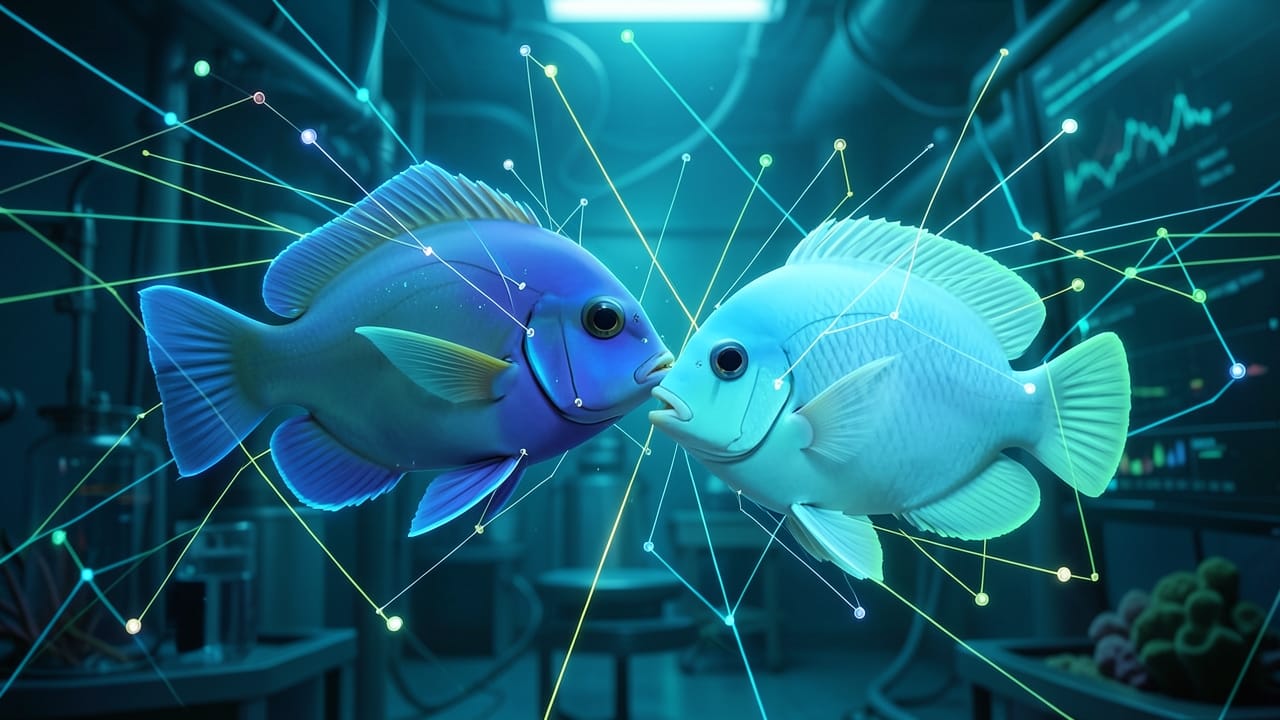
At the heart of this study is the fascinating symbiotic relationship between two marine species: the cleaner wrasse (Labroides dimidiatus) and the powder blue tang (Acanthurus leucosternon). Cleaner wrasses are renowned for their 'cleaning stations' on coral reefs, where they remove parasites and dead tissue from other fish, known as clients. This mutualistic interaction benefits both parties: the cleaner gets a meal, and the client benefits from parasite removal.
Understanding the nuances of these interactions—when they begin, how long they last, and the specific behaviors involved—provides critical insights into marine ecosystems, evolution, and animal cognition. However, continuously monitoring and annotating these behaviors, especially in complex environments, is incredibly challenging. This study's focus on a controlled laboratory setting allowed for precise tracking and analysis, laying the groundwork for future field applications.
Also Read: 10 mind blowing ai tools you must try in 2026
The Technology Behind the Breakthrough: DeepLabCut and AI Classification
Markerless Pose Estimation with DeepLabCut
The foundation of this semi-automated system is DeepLabCut, an open-source, deep learning-based toolbox for markerless pose estimation. Unlike traditional methods that require attaching physical markers to animals, DeepLabCut uses neural networks to infer the positions of specific body parts (keypoints) directly from video frames. This is a game-changer for ethology, as it allows for the non-invasive tracking of animal movement with remarkable precision.
In this study, DeepLabCut was trained on labeled frames to produce simultaneous pose estimates for both the cleaner wrasse and the powder blue tang. This involved identifying and tracking key anatomical points on each fish, even as they moved and interacted within the three-dimensional laboratory environment.
The Classification Pipeline
Following pose estimation, the tracked keypoint data underwent a crucial step: feature engineering. This process involved extracting meaningful numerical features from the raw tracking data—such as relative distances between fish, body orientations, and movement speeds—that are indicative of a cleaning interaction. These engineered features then served as input for a supervised classification algorithm.
The classifier, trained on annotated examples of both cleaning interactions and non-interactions, learned to distinguish between these behavioral states. Its primary function was to label 'interaction windows' within the video footage, effectively identifying the precise moments when cleaning was occurring.
Key Findings and Performance Metrics
The researchers reported impressive performance metrics for their semi-automated pipeline. The system demonstrated a high degree of accuracy in detecting cleaning interactions, significantly reducing the manual effort required for analysis.
Also Read: What is NotebookLM used for?
Automated System Performance Summary
| Metric | Value | Impact |
|---|---|---|
| Interaction Detection Accuracy | 90% | High reliability for identifying genuine cleaning events. |
| Non-Interaction Misclassification | ~15% | Approximately 15% of non-interactions were incorrectly flagged as interactions, indicating a manageable false-positive rate. |
| Footage Reduction for Manual Review | 75% | The system identified 25% of footage as containing interactions, reducing the volume requiring human annotation by three-quarters. |
| Volume of Footage Flagged with Interactions | 25% | Only a quarter of the total video content needed further human validation for interactions. |
This remarkable reduction in manual annotation time—by 75%—underscores the immense practical value of this approach for researchers in behavioral ecology. It means that studies requiring extensive video analysis can be conducted much faster and with greater efficiency.
Broader Implications for Behavioral Ecology
Bridging the Gap: Lab vs. Field Challenges
The successful deployment of markerless pose estimation combined with machine learning for behavioral analysis represents a significant advancement. Pipelines like DeepLabCut are increasingly common for replacing labor-intensive video annotation. However, the study also implicitly highlights the inherent differences between controlled laboratory environments and complex field settings.
Challenges of Deploying Automated Behavioral Analysis
| Aspect | Controlled Laboratory Setting (as in this study) | Complex Field Environment |
|---|---|---|
| Lighting | Consistent, uniform, and optimal for recording. | Highly variable, natural light, shadows, glare, rapid changes. |
| Occlusion | Minimal, predictable, engineered for clear views. | Frequent and unpredictable (vegetation, other animals, environmental structures). |
| Number of Individuals | Limited, isolated, specific subjects. | Many individuals, diverse species, complex interactions. |
| Background Complexity | Simple, often uniform, high contrast with subjects. | Highly variable, cluttered, naturalistic, low contrast. |
| Generalization | High performance within trained, controlled conditions. | Significant challenges due to variability and novel scenarios. |
| Data Collection | Standardized, high-quality, stable camera setup. | Diverse, often lower quality, prone to environmental factors and movement. |
While the achieved accuracy in a laboratory setting is commendable, generalizing these models to the unpredictable conditions of natural environments—with varying lighting, occlusions, and multiple interacting individuals—remains a significant challenge for the industry. This is a common pattern observed when deploying similar pipelines.
The Role of Human Oversight in Automated Workflows
The reported 15% false-positive rate, where non-interactions are misclassified as interactions, highlights an important trade-off between recall (identifying most true interactions) and reviewer burden. Even with 75% of footage pre-filtered, the remaining 25% that is flagged as containing interactions still requires human validation. This human oversight is crucial for refining annotations, evaluating model performance, and ensuring the integrity of downstream scientific conclusions.
The Road Ahead: What to Watch For
For observers and practitioners in AI and behavioral ecology, exploring the best free courses to boost your career while monitoring these key developments will be important:
- Code and Dataset Release: The availability of the researchers' code and annotated datasets would be invaluable for reproducibility and further research.
- External Validation: Testing the pipeline on field-collected reef footage would be a crucial next step to assess its robustness and generalizability beyond controlled lab conditions.
- Reducing False Positives: Exploring advanced techniques such as temporal smoothing of predictions or employing ensemble classifiers could help mitigate the false-positive rate.
- Adaptation to Complex Setups: Extending the system to handle multi-species or multi-camera setups would open doors to studying even more complex ecological interactions.
- Final Publication: As this is an unedited preprint, the final published version may include revisions to methods or metrics, which should be noted.
Conclusion: A Glimpse into the Future of Ethology
This study represents a solid, domain-specific demonstration of markerless pose estimation applied to ethology. It offers immense practical value for researchers and ML practitioners working with behavioral datasets, proving that combining advanced AI with biological research can yield powerful tools for discovery. While its immediate field impact may be limited by its controlled-lab scope, it undeniably paves the way for a future where AI-driven analysis accelerates our understanding of animal behavior, revealing the hidden intricacies of the natural world with unprecedented detail and efficiency.
Frequently Asked Questions
What is DeepLabCut?
DeepLabCut is an open-source, deep learning-based toolbox for markerless pose estimation. It uses neural networks to infer the positions of specific body parts (keypoints) from video frames, enabling non-invasive tracking of animal movement without requiring physical markers.
What are fish cleaning interactions?
Fish cleaning interactions are a form of mutualistic symbiosis, typically seen on coral reefs, where cleaner fish (like the cleaner wrasse) remove parasites, dead tissue, or mucus from 'client' fish (like the powder blue tang). The cleaner gets food, and the client benefits from improved health.
What was the accuracy of the automated system in detecting interactions?
The semi-automated pipeline achieved a 90% accuracy rate in detecting cleaning interactions between the cleaner wrasse and the powder blue tang in a controlled laboratory setting.
What are the main limitations of this study?
The study was conducted in a controlled three-dimensional laboratory setting. Generalizing the system to complex field environments with variable lighting, occlusions, and multiple interacting individuals presents significant challenges that were not addressed in this particular research.
Why is automating behavioral detection important for researchers?
Automating behavioral detection drastically reduces the labor-intensive and time-consuming process of manual video annotation. This efficiency allows researchers to analyze larger datasets, accelerate the pace of scientific discovery, and focus more on hypothesis testing and interpretation.