
Beyond Instinct: The Physics Governing Bird Flocks and Fish Schools
For centuries, the mesmerizing spectacle of a bird flock or a school of fish moving as one has been attributed primarily to complex animal behavior—a symphony of individual creatures instinctively copying their neighbors. This ‘neighbor-to-neighbor’ paradigm, focusing on eyesight and instinct, has long guided scientific understanding.
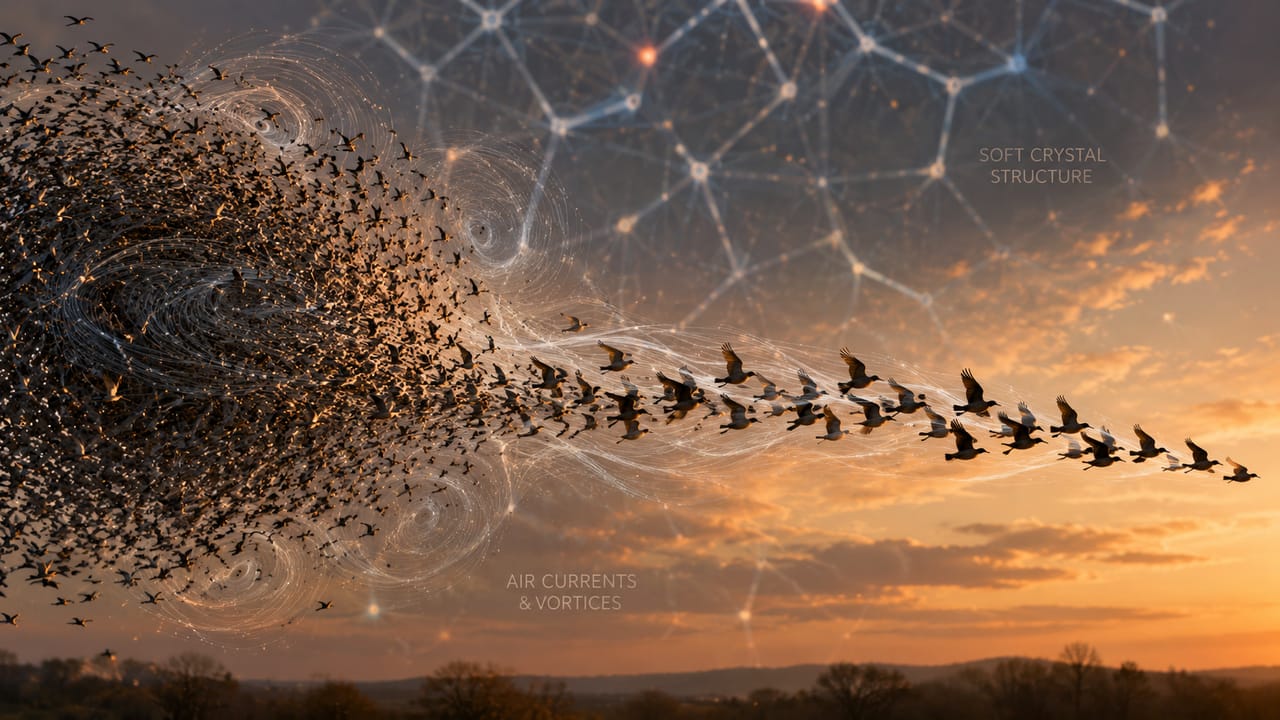
However, groundbreaking research from New York University (NYU) is challenging this view, proposing that the intricate organization of these collectives is deeply rooted in the fundamental principles of physics, specifically the dynamics of the air and water they navigate.
Also Read: AI Revolutionizes Fish Behavior Study: Automated Cleaning
The Crystal Analogy: Flocks as "Soft Crystals"
A team of mathematicians at NYU's Applied Mathematics Laboratory, including Christiana Mavroyiakoumou, Leif Ristroph, and Jiajie Wu, embarked on a quest to look beyond mere animal behavior. Their focus shifted to the disturbed fluid—the air and water—that these creatures interact with. What they uncovered was a profound parallel: when strung out in a line, a flock behaves less like a collection of independent entities and more like a structured material. Specifically, they likened these formations to "soft crystals."
In this intriguing analogy, each animal assumes the role of an atom, maintaining an orderly, repeating pattern. But unlike traditional crystals, where rigid atomic bonds dictate structure, here the 'bonds' are invisible—they are the dynamic forces generated by the moving fluid. The air and water displaced by a flapping wing or swishing tail create swirling vortices. These fluid flows, rather than solely eyesight or instinct, nudge neighbors into their precise positions, locking them into a kind of dynamic, fluid-driven grid.
Invisible Bonds: The Role of Fluid Dynamics
Every movement an animal makes in a fluid leaves a lasting impression. A flapping wing or tail generates a trail of swirling vortices, wakes that profoundly affect those following behind. The researchers discovered a precise give-and-take: move too close, and the flow pushes you back; drift too far, and it pulls you forward. This intricate balance parks each member at a preferred, energetically optimal gap—roughly 1.2 times the wavelength a leader carves as it flaps.
Also Read: Science Breakthroughs & Innovations Quiz: This Week's Discoveries
This isn't merely about aesthetic formation; there’s a significant aerodynamic and hydrodynamic payoff. Trailing birds, for instance, can catch lift from the one ahead, significantly reducing their energy expenditure. A study on migrating ibis, for example, revealed that they consistently slot into just the right spot to ride this rising air, demonstrating a natural optimization that the physics model now helps explain. This physical interaction ensures that if a follower is pushed off its mark, the fluid flow itself acts as a spring, gently guiding it back into position.
Comparing Traditional vs. Physics-Based Models of Flocking
| Feature | Traditional (Animal Behavior) Model | Physics-Based (Fluid Dynamics) Model |
|---|---|---|
| Primary Organizing Principle | Individual copying, instinct, eyesight | Fluid dynamic forces (vortices, pressure gradients) |
| Mechanism for Spacing | Unspecified or sensory perception | Precise push-pull forces from fluid wakes, preferred gap |
| Explanation for Cohesion | Social cues, collective decision-making | Invisible physical bonds formed by fluid interactions |
| Insights on Formation Size | Limited explanation for size limits | Predicts a 'hard ceiling' on stable column size |
| Response to Disturbances | Individual adjustments, communication | Propagation and amplification via 'flonons' |
| Energy Efficiency | Observed but mechanism less clear | Directly linked to harnessing leader's wake for lift/thrust |
Empirical Validation: The Mechanical Flocking Experiment
To rigorously test their theory, the NYU team didn't just rely on mathematical models. They drew upon a decade of prior bench experiments, notably involving a mechanical stand-in for a flock. This ingenious setup utilized 3D-printed plastic wings, powered by small motors, free to flap within a tank of water. Five such 'flappers' were observed as they propelled themselves in single file.
Remarkably, these inanimate machines, guided solely by the currents they created and encountered, settled into evenly spaced positions, precisely as the mathematical model predicted. This formation flight, recreated with little more than plastic and motors, provided compelling evidence. As Mavroyiakoumou stated, "Our findings offer a new way to understand how animal collectives coordinate movement and respond to their environment." The striking match between the machine behavior and the mathematical predictions strongly suggested that simple flow rules, rather than complex decision-making, are the primary drivers behind the orderly columns observed in nature.
Flonons: Ripples of Disturbance and Amplification
The orderly picture revealed by the new model comes with a fascinating, and somewhat counterintuitive, catch. If one member of the linear formation is disturbed—a slight wobble or a deviation—the effect doesn't simply die out. Instead, it travels down the formation, growing stronger as it propagates. These traveling disturbances have been christened "flonons" by the researchers, a nod to phonons, the waves that ripple through ordinary crystalline solids.
Earlier experiments with flapping wings had already hinted at this phenomenon, observing a wobble swelling towards the back of a group until the machines eventually collided. What was missing, until this study, was a comprehensive model explaining why these waves amplify and how far a column can stretch before its integrity breaks. The new mathematical framework now provides both, revealing a crucial insight: because each animal feels the wake of the one ahead but cannot push back on it effectively, a small jitter only feeds forward, building upon itself and swelling as it traverses the length of the group.
The Delicate Balance: Why Flocks Stay Small
This feed-forward mechanism, where disturbances amplify down the line, imposes a strict natural limit on the size of a stable, tidy column. When the numbers are crunched across various body sizes and flapping speeds, the model consistently predicts a "hard ceiling" of approximately four to nine members. Beyond this range, the swelling flonons force a collision, leading to the fracture of the formation.
The window for maintaining a safe formation is surprisingly narrow. A bird or fish near the back of the column might have as little as two to five flaps of its wings to correct its course before it inevitably slams into the neighbor ahead. Miss that critical beat, and the formation fractures. This explains why very long, perfectly straight lines of animals are rarely observed in nature, despite the apparent benefits of cooperative movement.
Factors Influencing Flocking Stability and Size
| Factor | Influence on Stability/Size | Explanation |
|---|---|---|
| Fluid Dynamic Forces | Stabilizing (short term) | Push-pull mechanism helps maintain preferred spacing. |
| Preferred Gap | Stabilizing | Optimal distance (approx. 1.2x leader's wave) minimizes energy use and maximizes lift. |
| Flonon Amplification | Destabilizing | Disturbances grow stronger down the line, leading to collisions. |
| Feed-Forward Mechanism | Destabilizing | Inability of followers to push back on leader's wake exacerbates disturbances. |
| Number of Members | Destabilizing (above threshold) | Hard ceiling of 4-9 members for stable linear formations; larger groups become unstable. |
| Response Time | Critical for stability | Limited number of flaps (2-5) for a follower to correct course before collision. |
Fragility as a Strength: Responsiveness to the Environment
Paradoxically, this inherent fragility of linear formations carries a significant upside. The very springiness that can cause a column to shatter also makes it exquisitely sensitive to the faintest external shove. This heightened sensitivity could be a crucial evolutionary advantage, allowing a flock or school to respond with remarkable swiftness to sudden environmental cues, such as an unexpected gust of wind or the sudden appearance of a predator.
In essence, fragility and responsiveness emerge as two sides of the same coin. A system that is easily disturbed is also a system that can quickly detect and react to changes, suggesting a sophisticated interplay between physical constraints and adaptive behavior.
Paving the Way for Future Innovations
This research marks a significant leap in our understanding of collective animal behavior. Previously, scientists could observe pairs of birds locking together or watch larger groups descend into chaos, but they lacked a comprehensive explanation for the precise spacing within a column or the exact reasons why such formations could only grow so large. The new mathematical framework provides this missing "rulebook."
The implications extend far beyond basic science. Engineers, particularly those developing drone swarms and autonomous underwater robots, stand to benefit immensely. By understanding the flow tricks that allow animals to optimize their energy and maintain formation, future robotic systems could be designed to pack closer together, avoid chaotic pile-ups, and harness environmental energy more efficiently. What once appeared to be a feat of complex animal teamwork is now revealing itself to be a masterful exploitation of physical laws, with the birds and fish, of course, still needing to sense and respond, but the underlying order inscribed in the fluid flows themselves. The study was published in the esteemed journal Physical Review Fluids.
Test Your Knowledge: Bird Flocks and Physics Quiz!
REPORT CARD
ATTEMPTED QUESTIONS: 0CORRECT ANSWERS: 0
WRONG ANSWERS: 0
PRACTICE REGULARLY!