
Scientists Expected a Black Hole, But Found a Giant Stellar Neutrino Factory Instead
For decades, the universe's most energetic neutrinos—often called "ghost particles" due to their elusive nature—were thought to originate primarily from the violent vicinities of black holes. These enigmatic particles, which pass through planets, stars, and even entire galaxies almost without interaction, have presented one of astrophysics' most enduring mysteries.
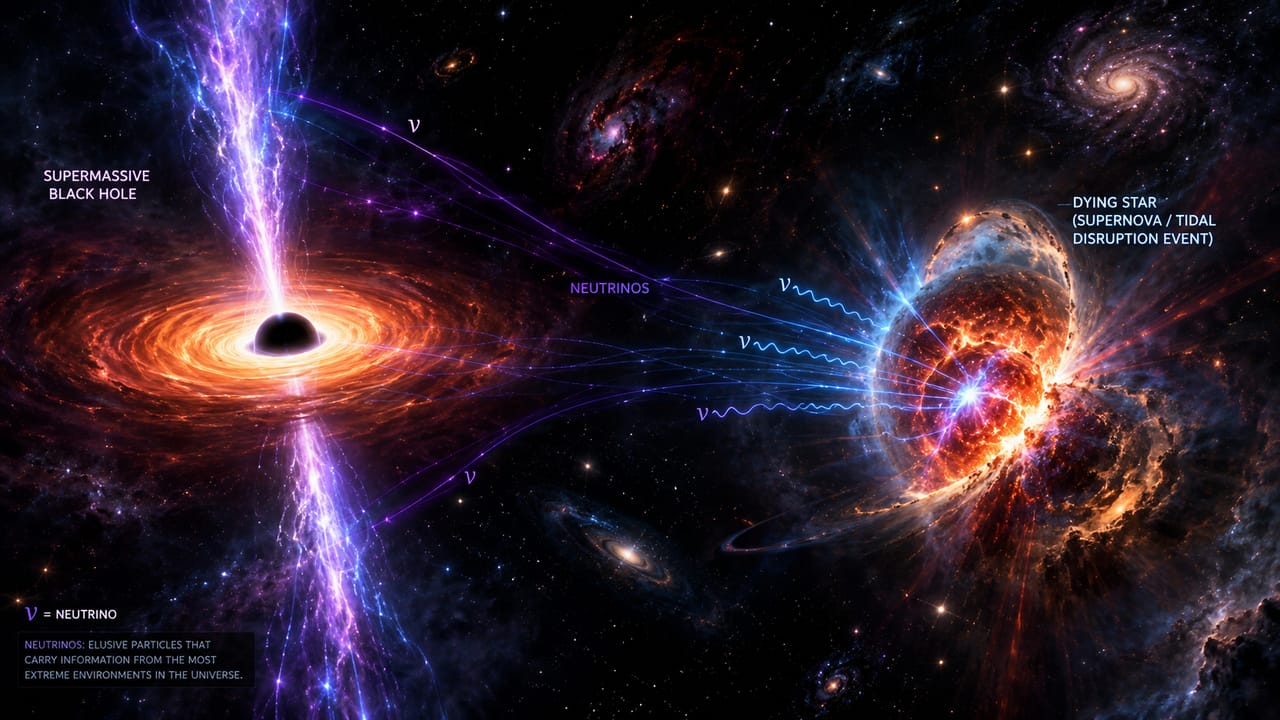
However, a seismic shift in scientific understanding is now suggesting that massive stars and the dramatic events surrounding their demise could be the universe's true, vast neutrino factories, redefining our cosmic particle map.
The Cosmic Ghost Particle Mystery: Unveiling Neutrinos
Neutrinos are fundamental particles that carry almost no mass, possess no electric charge, and interact so weakly with matter that trillions pass through the human body every second unnoticed. This extraordinary property, while making them incredibly difficult to detect, also makes them invaluable cosmic messengers. Unlike light, which can be absorbed, scattered, or blocked by interstellar dust and gas, neutrinos travel almost unimpeded across billions of light-years, carrying pristine information directly from the universe's most extreme environments.
Key Properties and Significance of Neutrinos
To appreciate their role as cosmic detectives, it's essential to understand the unique characteristics of neutrinos:
| Property | Description | Significance in Astrophysics |
|---|---|---|
| Mass | Extremely small, non-zero (unlike photons); exact value still unknown. | Influences particle physics models and cosmological theories, proving the Standard Model of particle physics is incomplete. |
| Electric Charge | None (electrically neutral particle). | Allows them to pass through matter unimpeded by electromagnetic forces, making them perfect deep-space probes. |
| Interaction Strength | Very weak; primarily interact via the weak nuclear force and gravity. | Earns them the nickname "ghost particles"; makes detection extremely challenging, requiring massive underground or underwater observatories like IceCube. |
| Speed | Nearly the speed of light. | Enables them to travel vast cosmic distances quickly, bringing information from distant and ancient events. |
| Origin | Nuclear reactions in stars (e.g., the Sun), supernovae, cosmic ray interactions, particle accelerators, and primordial processes from the Big Bang. | Provides insights into the interiors of stars, explosive stellar deaths, and particle acceleration mechanisms in exotic cosmic objects. |
The Black Hole Hypothesis: A Reigning Theory Challenged
For years, supermassive black holes sat atop the list of potential sources for high-energy neutrinos. The reasoning seemed sound: black holes are among the most extreme objects in existence, capable of accelerating matter to extraordinary energies as it spirals towards their event horizons. This process can unleash enormous amounts of energy, generating powerful magnetic fields, intense radiation, and relativistic particle jets – conditions thought ideal for producing the highest-energy neutrinos.
Why Black Holes Seemed Like the Obvious Answer
Observatories like IceCube in Antarctica, a massive detector buried beneath the South Pole ice, have recorded these elusive particles. The initial assumption was that if any cosmic environment could launch neutrinos across billions of light-years, it would be these gravitational powerhouses. Data from NASA's Chandra, Swift, and NuSTAR observatories even seemed to support this, suggesting that Sagittarius A*, the supermassive black hole at the center of the Milky Way, might be a potent source.
Astrophysicist Yang Bai of the University of Wisconsin aptly summarized the challenge, stating, "Figuring out where high-energy neutrinos come from is one of the biggest problems in astrophysics today." The case for black holes looked increasingly convincing.
Also Read: Could Dying Stars Birth New Universes?
The AT2019dsg Anomaly: A Shift in Perspective
The clear picture began to blur with the detailed study of a dramatic event known as AT2019dsg. This event, a Tidal Disruption Event (TDE), occurred when a star wandered too close to a supermassive black hole and was ripped apart by immense tidal forces. TDEs are some of the cosmos's most violent phenomena, releasing prodigious amounts of energy as stellar material is shredded and consumed.
When Expectations Fell Short: The Case of AT2019dsg
When the IceCube Observatory detected a powerful neutrino that appeared to coincide with AT2019dsg, researchers initially hailed it as a "smoking gun" discovery. The timing and location matched perfectly, seemingly confirming the black hole hypothesis.
However, a closer, more extensive look using radio observations, detailed in the study ‘Radio Observations of an Ordinary Outflow from the Tidal Disruption Event AT2019dsg,’ revealed a different story. Researchers found that the event, despite its violent nature, simply did not release enough energy to account for the detected high-energy neutrino. The outflow from the disrupted star appeared relatively ordinary, rather than exceptionally powerful.
Yvette Cendes, lead author of a study examining the event, encapsulated this finding with the remark: "Black holes are not like vacuum cleaners." This statement challenges a common misconception. Contrary to popular imagination, black holes do not indiscriminately devour everything around them at extreme speeds. Many accrete matter at rather low rates, and not all accretion activities generate the ultra-harsh conditions required for high-energy particle creation. These results prompted a critical re-evaluation: perhaps black holes were only half the story.
The Emergence of Stellar Neutrino Factories
The AT2019dsg anomaly spearheaded a renewed interest in stars themselves, particularly those undergoing dramatic transformations. The death throes of giant stars, intense stellar explosions (like supernovae), and even the intricacies of tidal disruption events began to be seen as potential sites for creating very energetic environments capable of accelerating particles to create high-energy neutrinos.
From By-products to Participants: Neutrinos in Stellar Collapse
Research titled ‘High Energy Neutrinos from the Tidal Disruption of Stars’ by physicists Cecilia Lunardini and Walter Winter highlighted that TDEs could contribute significantly to the population of neutrinos detected by IceCube. Their work indicated that the complex physics surrounding disrupted stars might be far more important than previously thought.
More recent theoretical studies have pushed this concept even further. Some researchers now describe collapsing stars as natural "neutrino colliders." In these cataclysmic environments, immense numbers of neutrinos interact, not merely as passive by-products of stellar destruction, but as active participants that influence the ultimate fate of the dying star. They can help determine whether a collapsing star stabilizes into a neutron star or continues its unstoppable collapse into a black hole.
The Broader Cosmic Picture: Black Holes vs. Massive Stars
This represents a subtle but profound shift in perspective. Rather than viewing black holes as the sole engines behind the universe's most energetic neutrinos, scientists are now embracing a broader, more interconnected picture. Massive stars, their explosive deaths, and the complex physics surrounding them may all contribute to a cosmic network of particle production.
| Feature | Traditional View (Black Holes) | Emerging View (Massive Stars/TDEs) |
|---|---|---|
| Primary Source Assumption | Supermassive black holes, especially at galactic centers (e.g., active galactic nuclei). | Massive stars (during supernova explosions, stellar collapse), Tidal Disruption Events (TDEs), and other energetic stellar phenomena. |
| Mechanism for Neutrino Production | Acceleration of matter spiraling into black holes; powerful relativistic jets; particle-particle collisions in extreme environments. | Violent events surrounding stellar death; particle acceleration in stellar outflows; interactions within the dense, hot cores of collapsing stars; specific TDE dynamics. |
| Energy Release Source | Extreme gravitational forces; magnetic fields; radiation from accretion disks. | Intense nuclear fusion leading to collapse; shock waves from supernova explosions; gravitational energy release during stellar collapse; tidal forces tearing stars apart. |
| Initial Observational Support | Data from Chandra, Swift, NuSTAR linking high-energy events to black holes (e.g., Sagittarius A*). | Later radio observations (e.g., AT2019dsg) showing insufficient black hole energy for observed neutrinos; theoretical models suggesting stellar mechanisms are robust. |
| Neutrino Role | Primarily a by-product of extreme black hole activity; serve as messengers. | Active participants in stellar collapse (e.g., determining stellar fate); also serve as messengers; intrinsic to the physics of the event. |
| Overall Picture | Black holes as dominant, often singular, engines for high-energy neutrinos. | A broader, interconnected cosmic network of particle production, with diverse stellar sources playing a significant role alongside black holes. |
Also Read: Solar Wind Measurement Breakthrough & Space Weather Quiz
Conclusion: An Evolving Understanding of the Universe's Most Energetic Phenomena
The mystery of high-energy neutrinos is far from solved. Each new neutrino detected on Earth, often by monumental efforts at observatories like IceCube, carries information from distant and frequently violent corners of the universe. This evolving understanding reminds astronomers that nature rarely confines itself to a single explanation. Sometimes, the object expected to dominate the story—the black hole—turns out to share the stage with the stars, revealing a universe even more complex and interconnected than previously imagined.
Test Your Knowledge: Neutrino Astrophysics Quiz
Challenge yourself with these multiple-choice questions based on the article above.
REPORT CARD
ATTEMPTED QUESTIONS: 0CORRECT ANSWERS: 0
WRONG ANSWERS: 0
PRACTICE REGULARLY!
Frequently Asked Questions
What are "ghost particles"?
Ghost particles are neutrinos, nicknamed for their elusive nature. They have almost no mass, no electric charge, and interact so weakly with matter that trillions can pass through objects like planets and stars without leaving a trace.
Why were black holes initially considered the primary source of high-energy neutrinos?
Black holes were considered the primary source because they are among the most extreme objects in existence, capable of accelerating matter to extraordinary energies. The immense gravitational forces and energetic processes around them were thought to be ideal for generating high-energy particles like neutrinos.
What is a Tidal Disruption Event (TDE)?
A Tidal Disruption Event (TDE) occurs when a star wanders too close to a supermassive black hole and is torn apart by the black hole's immense tidal forces. These events release vast amounts of energy as stellar material is shredded and consumed.
Why did the AT2019dsg event challenge the black hole hypothesis?
Although the IceCube Observatory detected a powerful neutrino coinciding with AT2019dsg (a TDE), subsequent extensive radio observations revealed that the event simply did not release enough energy to account for the detected neutrino, suggesting black holes might not be the sole or primary source in all such events.
How do massive stars act as "neutrino factories"?
Massive stars, particularly during their explosive deaths (like supernovae) and collapse, create extremely energetic environments. These conditions can accelerate particles to generate high-energy neutrinos. In some theories, collapsing stars even act as "neutrino colliders," where neutrinos actively interact and influence the star's ultimate fate, such as whether it becomes a neutron star or a black hole.