
A Spectacular Cosmic Light Show Captured from Orbit
From their unique vantage point aboard the International Space Station (ISS), approximately 250 miles (400 kilometers) above Earth, astronauts frequently witness sights that leave even the most seasoned spacefarers in absolute awe. Recently, a NASA astronaut shared a breathtaking time-lapse video and imagery of a dazzling aurora dancing across Earth's atmosphere, describing the display as "absolutely spectacular."
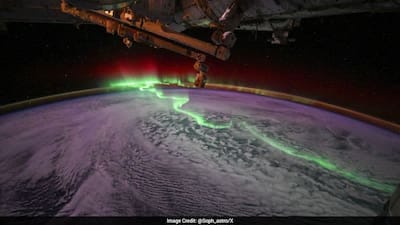
As the ISS transited over the southern hemisphere, the glowing green and red ribbons of the Aurora Australis (Southern Lights) draped across the horizon, illuminated by the interaction of solar wind with Earth's magnetic field. This celestial display is not just a visual marvel; it is a vivid demonstration of the dynamic relationship between our Sun and Earth's protective magnetosphere.
The Science Behind the Glow: How Auroras Form
Auroras are initiated by the Sun, which constantly releases a stream of charged particles known as the solar wind. During periods of high solar activity—such as solar flares or coronal mass ejections (CMEs)—the Sun launches billions of tons of high-energy plasma into space.
When these charged particles reach Earth, they are guided by our planet's magnetic field lines toward the polar regions. As they plunge into the upper atmosphere, they collide with gas molecules like oxygen and nitrogen. These collisions transfer energy to the atmospheric gases, exciting them. When the gas molecules return to their ground state, they release this energy in the form of light (photons).
Also Read: Chinese AI Tracks Space Hurricanes: Unveiling the Ionosphere
Atmospheric Chemistry and Aurora Colors
The specific colors of an aurora depend on the type of gas molecule involved in the collision and the altitude at which the interaction occurs. Below is a breakdown of how different gases generate these ethereal colors:
| Gas Molecule | Altitude Range | Resulting Color | Scientific Significance |
|---|---|---|---|
| Oxygen (O) | Lower Altitude (Up to 150 miles / 241 km) | Bright Green / Yellow-Green | The most common aurora color; highly visible to the human eye. |
| Oxygen (O) | High Altitude (Above 150 miles / 241 km) | Deep Red | Rare and associated with intense solar storms. |
| Nitrogen (N₂) | Lower Altitude (Below 60 miles / 96 km) | Blue, Violet, or Crimson Edge | Requires high-energy particles to excite; indicates deep atmospheric penetration. |
Why Astronauts Have the Best Seat in the House
While skywatchers on Earth must contend with weather, cloud cover, and light pollution, astronauts aboard the ISS orbit above the weather systems. From this orbital altitude, they can look horizontally through the ionosphere, observing the aurora's vertical structure in three dimensions. On certain orbits, the space station even flies directly through the glowing curtains of charged particles, giving astronauts the sensation of traveling through a luminous green fog.
Also Read: NASA's Roman Telescope: Unveiling the Universe's Secrets
Aurora Borealis vs. Aurora Australis
Depending on the orbital path of the ISS, astronauts can capture both northern and southern auroral displays. While scientifically identical in mechanism, they occur at opposite poles:
| Feature | Aurora Borealis | Aurora Australis |
|---|---|---|
| Common Name | Northern Lights | Southern Lights |
| Location | Northern Hemisphere (Arctic Circle, Canada, Scandinavia) | Southern Hemisphere (Antarctica, Southern Ocean, New Zealand) |
| Peak Visibility Months | September to April | March to September |
| ISS Capture Frequency | High (frequent landmass transits) | High (spectacular ocean-horizon transits) |
Solar Cycle 25: A Golden Era for Aurora Chasers
The intensity and frequency of recent auroral displays are tied directly to the solar cycle. The Sun operates on an approximate 11-year cycle of activity, transitioning from a quiet phase (solar minimum) to an active phase (solar maximum). Currently, we are in the midst of Solar Cycle 25, which is proving to be much more active than scientists initially projected.
This heightened solar activity means more frequent coronal mass ejections, resulting in powerful geomagnetic storms that push auroral displays much further toward the equator than usual. This explains why millions of people globally, along with astronauts on the ISS, have been treated to some of the most spectacular auroral displays witnessed in decades.
Test Your Knowledge: Interactive Aurora Quiz
Think you are an expert on auroras, space observation, and atmospheric science? Test your knowledge with our 10-question multiple-choice quiz below!
REPORT CARD
ATTEMPTED QUESTIONS: 0CORRECT ANSWERS: 0
WRONG ANSWERS: 0
PRACTICE REGULARLY!
Frequently Asked Questions
What is an aurora?
An aurora is a natural light display in Earth's sky, predominantly seen in high-latitude regions, caused by collisions between charged particles from the Sun and gases in the Earth's atmosphere.
How do astronauts see auroras from space?
Astronauts aboard the International Space Station (ISS) see auroras from above, looking down or horizontally through the atmospheric layers. Sometimes, the ISS flies directly through the glowing regions.
Why is the aurora green?
The common green color is produced when charged solar particles collide with oxygen molecules in the lower thermosphere, at altitudes up to 150 miles.