
How Genomics is Revolutionizing Glaucoma Care: Insights from GENE-SIGHT 2026
Glaucoma, often termed the “silent thief of sight,” is one of the leading causes of irreversible blindness globally. In India, where millions are affected, traditional diagnostic methods often catch the disease only after substantial, permanent damage has occurred to the optic nerve. However, a major paradigm shift is on the horizon.
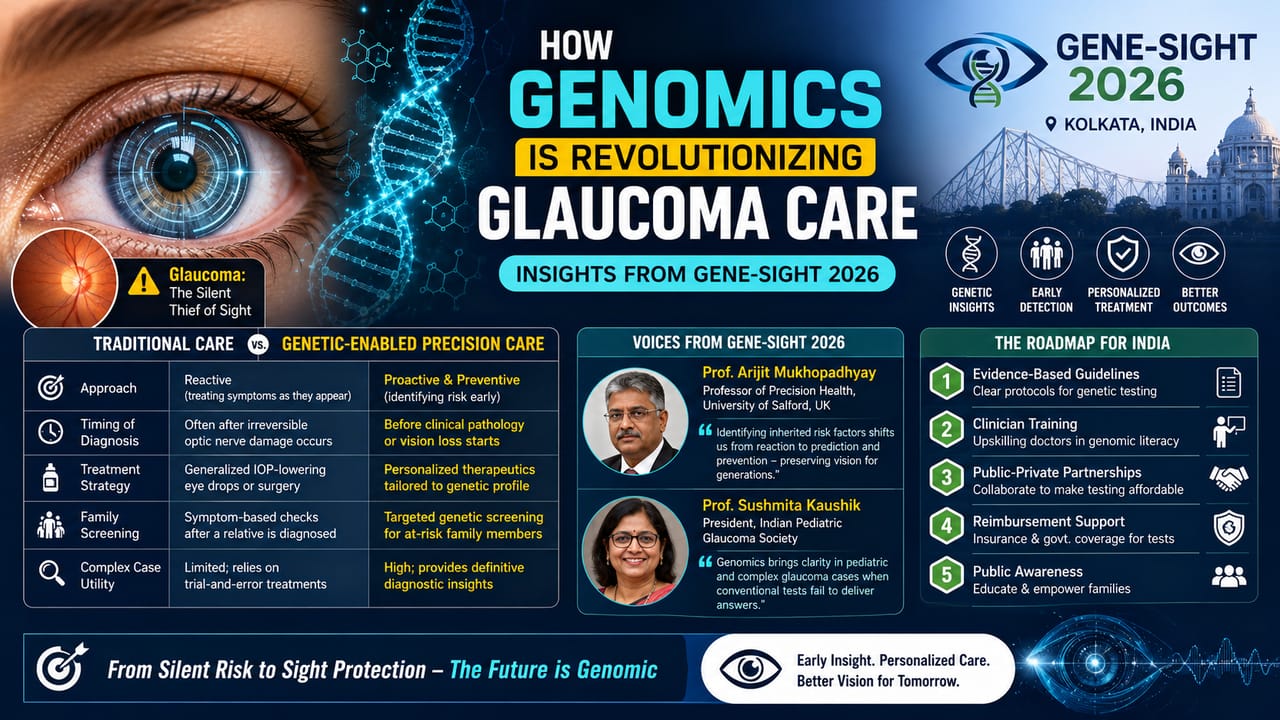
At the Genetics-enabled Social Innovation for Glaucoma Health & Treatment (GENE-SIGHT) 2026 conference, held in Kolkata, India, pioneering ophthalmologists, geneticists, policymakers, and industry leaders made a resounding call to integrate genetic testing into routine ophthalmic care. The landmark event highlighted how genetic mapping can transition glaucoma care from late-stage reaction to proactive, personalized prevention.
Also Read: Beyond Medicine: TB Diet Kits Boost Recovery in Yamunanagar
Why Glaucoma Diagnostics Must Move Beyond the Clinic
Conventional glaucoma detection relies heavily on measuring intraocular pressure (IOP), assessing the visual field, and imaging the optic nerve. While effective, these parameters often change only after significant retinal ganglion cell loss has occurred. Genetic testing offers a look at the blueprint of a patient's health before clinical symptoms manifest.
Genetic markers can identify high-risk individuals decades before the onset of visual field defects. By detecting genetic mutations associated with early-onset or aggressive forms of glaucoma (such as mutations in the MYOC, OPTN, or CYP1B1 genes), healthcare providers can initiate early intervention strategies, customize therapeutic regimens, and closely monitor at-risk family members.
Traditional Care vs. Genetic-Enabled Precision Care
The table below highlights the stark contrast between standard clinical pathways and the genomic precision medicine discussed at GENE-SIGHT 2026:
| Feature | Traditional Glaucoma Care | Genetic-Enabled Precision Care |
|---|---|---|
| Primary Approach | Reactive (treating symptoms/damage as they appear) | Proactive & Preventive (identifying risk early) |
| Timing of Diagnosis | Often after irreversible optic nerve damage occurs | Before clinical pathology or vision loss starts |
| Treatment Strategy | Generalized IOP-lowering eye drops or surgery | Personalized therapeutics tailored to genetic risk profile |
| Family Screening | Symptom-based checks after a relative is diagnosed | Targeted genetic screening for high-risk family members |
| Complex Case Utility | Limited; relies on trial-and-error treatments | High; provides definitive diagnostic insights |
Also Read: Monsoon Viral Fever: Signs, Prevention & Treatment
Key Takeaways from the GENE-SIGHT 2026 Experts
Delivering the keynote address, Prof. Arijit Mukhopadhyay, Professor of Precision Health at the University of Salford, UK, emphasized the urgency of early intervention. He described how identifying inherited risk factors shifts the medical practice toward prediction and prevention. By understanding a patient's genetic predisposition, clinicians can preserve vision far more effectively than with standard pressure-reducing treatments alone.
Prof. Sushmita Kaushik, President of the Indian Pediatric Glaucoma Society, spoke on the critical role of genomics in pediatric and complex cases. In children and young adults, glaucoma can present aggressively and without typical warning signs. When clinical imaging and diagnostics fail to provide clear answers, genetic profiling can deliver the clarity needed to formulate immediate, sight-saving treatment plans.
The Roadmap to Implementation in India
Despite the immense promise of genomic ophthalmology, experts at the conference noted several barriers to widespread adoption across India. To successfully integrate genetic testing into routine care, the delegates urged action in five key areas:
- Evidence-Based Guidelines: Designing clear clinical protocols for when and how to administer genetic tests.
- Clinician Training: Educating ophthalmologists on interpreting genetic data and explaining risk profiles to patients.
- Public-Private Partnerships: Collaborating with biotechnology firms to lower the cost of genetic screening panels.
- Reimbursement Support: Encouraging insurance providers and government programs to cover genomic diagnostics.
- Public Awareness: Destigmatizing genetic conditions and educating families on the importance of hereditary screening.
Test Your Knowledge: GENE-SIGHT 2026 & Glaucoma Genetics Quiz
Do you understand how genomic medicine is reshaping eye care? Take our 10-question multiple-choice quiz below to test your understanding of the GENE-SIGHT 2026 conference and the clinical value of genetic testing!
REPORT CARD
ATTEMPTED QUESTIONS: 0CORRECT ANSWERS: 0
WRONG ANSWERS: 0
PRACTICE REGULARLY!
Frequently Asked Questions
What was the main focus of the GENE-SIGHT 2026 conference?
The main focus of the conference was on how genetics and genomic advancements can transform glaucoma management in India through early diagnosis, family screening, and precision medicine.
Who presented the keynote speech at the conference?
The keynote address was delivered by Prof. Arijit Mukhopadhyay, Professor of Precision Health at the University of Salford, UK.
Why is genetic testing particularly useful in pediatric glaucoma cases?
Genetic testing helps in pediatric and complex glaucoma cases by providing clear diagnostic answers when standard, conventional clinical diagnostic tools fail to show definitive results.