
The Race Against Bundibugyo: Containing a Rare and Deadly Ebola Strain
Global health authorities are racing against time to identify, develop, and deploy medical countermeasures to contain an unfolding Ebola outbreak in the eastern Democratic Republic of Congo (DRC). This outbreak is uniquely dangerous because it is driven by the Bundibugyo ebolavirus (BDBV) strain—a highly lethal species of the virus for which there are currently no approved vaccines, therapies, or standard treatments.
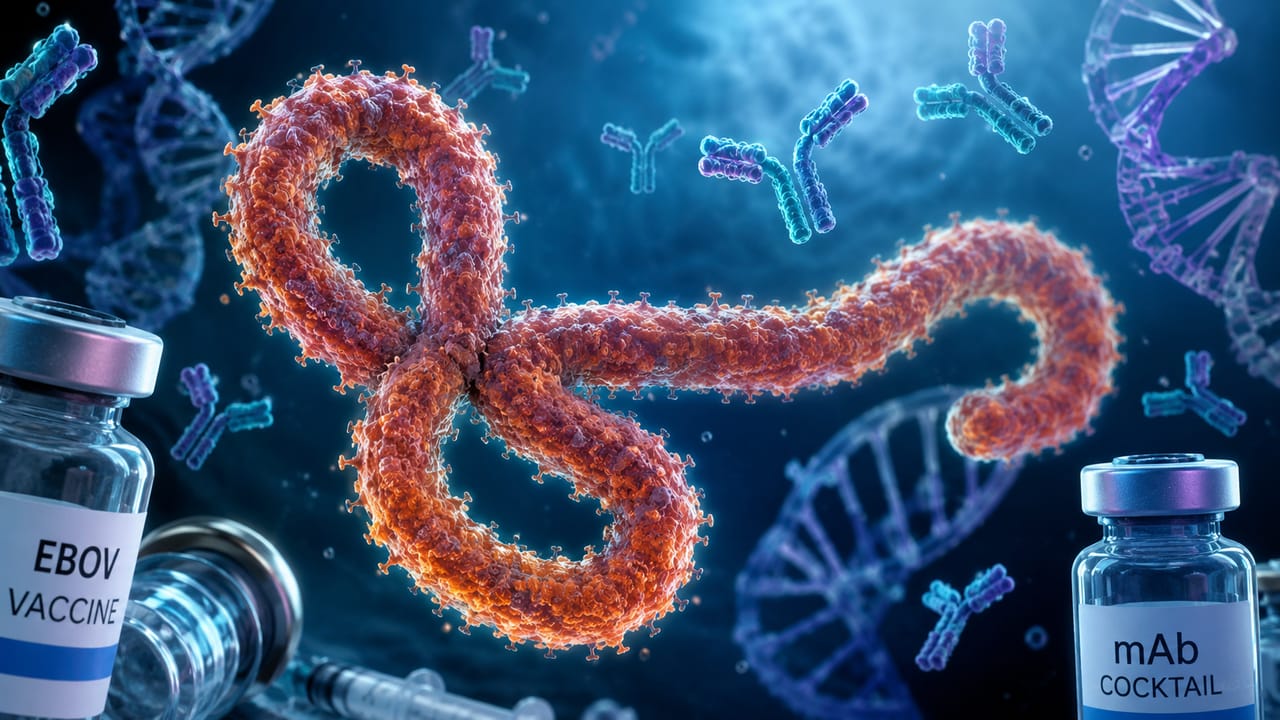
Historically, the highly publicized Ebola outbreaks in West Africa and the DRC have been caused by the Zaire ebolavirus strain. The success of vaccines like Merck's Ervebo and treatments like Inmazeb has given humanity powerful tools to fight the Zaire strain. However, those medical options offer little to no proven cross-protection against Bundibugyo, which has a devastating fatality rate of up to 40%. The Bundibugyo strain was first discovered in late 2007 during an outbreak in the Bundibugyo District of western Uganda, where it infected over 100 people and demonstrated its capacity for high mortality.
Also Read: Congo Ebola Outbreak: Key Facts & MCQs Quiz
With roughly 177 suspected deaths and nearly 750 suspected cases already reported in the current outbreak, the World Health Organization (WHO) has warned that caseloads could escalate rapidly without immediate intervention. Because no approved options exist, scientists are turning to a small cohort of experimental vaccines, antibody-based therapies, and oral antivirals, many of which are currently supported only by preclinical animal data.
Comparing Experimental Candidates for Bundibugyo Ebola
To help visualize the landscape of medical countermeasures currently in development or under consideration, the table below outlines the primary vaccine and therapeutic candidates, their mechanisms, developers, and current clinical status.
| Candidate Name | Type | Developer / Partners | Mechanism / Platform | Development Status |
|---|---|---|---|---|
| rVSVΔG/BDBV-GP | Vaccine | University of Texas Medical Branch (UTMB) / Merck tech | Recombinant vesicular stomatitis virus vector | Preclinical (100% protection in non-human primates) |
| ChAdOx1 BDBV | Vaccine | Serum Institute of India / CEPI / Oxford University | Chimpanzee adenovirus vector (ChAdOx1) | Preclinical; rapid emergency manufacturing underway |
| MBP134 | Antibody Therapy | Mapp Biopharmaceutical / BARDA | Pan-ebolavirus dual-monoclonal antibody cocktail | Phase 1 complete (proven safe in humans) |
| Maftivimab (Inmazeb component) | Antibody Therapy | Regeneron Pharmaceuticals | Monoclonal antibody targeting viral entry | Preclinical lab efficacy; 500 doses donated to WHO |
| BDBV289-N | Antibody Therapy | NIH / Academic researchers | Survivor-isolated monoclonal antibody | Preclinical (100% protection in monkeys post-infection) |
| Obeldesivir | Antiviral (Oral) | Gilead Sciences | Nucleoside analog prodrug (inhibits RNA polymerase) | Preclinical; predicted active based on Zaire/Sudan data |
| Remdesivir | Antiviral (IV) | Gilead Sciences | Nucleoside analog (intravenous infusion) | In vitro lab activity shows strong efficacy against BDBV |
Also Read: Malaria Deaths Rise Despite Vaccines: The Funding and Will to End Malaria Lacking
Deep Dive: The Experimental Vaccines in Development
1. The rVSVΔG/BDBV-GP Vaccine
This vaccine candidate leverages the exact same viral vector technology as Merck’s highly successful Ervebo vaccine, which was instrumental in ending recent Zaire ebolavirus outbreaks. In a landmark 2023 proof-of-concept study, researchers from the University of Texas Medical Branch (UTMB) demonstrated that rVSVΔG/BDBV-GP provided strong survival benefits in non-human primates. While talks are ongoing to scale up manufacturing, the WHO estimates it could take between six to nine months to produce a deployment-ready batch of this candidate.
2. The ChAdOx1 BDBV Vaccine
In response to the current crisis in the DRC, the Serum Institute of India, alongside the Coalition for Epidemic Preparedness Innovations (CEPI) and the University of Oxford, has initiated emergency manufacturing of the ChAdOx1 BDBV vaccine. Using the chimpanzee adenovirus vector platform (the same framework used in the highly distributed Oxford/AstraZeneca COVID-19 vaccine), this candidate represents the fastest potential route to vaccine deployment. The WHO indicated that doses could be ready in as little as two to three months, though animal trials must run concurrently to gather baseline safety and efficacy data.
Monoclonal Antibodies: Neutralizing the Virus directly
1. MBP134 (Mapp Biopharmaceutical)
MBP134 is a highly promising pan-ebolavirus therapeutic consisting of two human monoclonal antibodies. Funded in part by the U.S. Biomedical Advanced Research and Development Authority (BARDA), MBP134 has already been shown to be safe and well-tolerated in early-stage human clinical trials. Because MBP134 is engineered to target a highly conserved site across all ebolaviruses, preclinical models suggest it has robust activity against the Bundibugyo strain. BARDA and Mapp are actively coordinating emergency logistics for high-risk exposures.
2. Maftivimab (Regeneron)
Maftivimab is a component of Regeneron’s FDA-approved multi-antibody cocktail Inmazeb (used to treat Zaire ebolavirus). Laboratory assays have shown that Maftivimab isolated on its own exhibits binding and neutralizing activity against the Bundibugyo strain. To support the humanitarian response in the DRC, Regeneron has donated 500 doses of Inmazeb to the WHO, which may be deployed under compassionate-use guidelines while supply chains for Bundibugyo-specific agents are established.
3. BDBV289-N (Survivor-Derived Antibody)
In 2018, a scientific breakthrough showed that monoclonal antibodies isolated directly from human survivors of the original 2007 Bundibugyo outbreak could be utilized as a therapeutic. The lead candidate, BDBV289-N, demonstrated stunning efficacy in animal models supported by the U.S. National Institutes of Health (NIH), providing up to 100% protection in infected primates even when administered eight days after initial infection.
Antiviral Therapeutics and Diagnostics
Unlike monoclonal antibodies, which must be stored in cold-chain conditions and administered intravenously, small-molecule oral antivirals offer a highly scalable alternative for outbreak zones. Gilead Sciences' clinical candidate Obeldesivir is an oral antiviral that is predicted to have strong activity against the Bundibugyo strain. Animal trials of Obeldesivir demonstrated 100% protection against Zaire and Sudan strains when administered post-exposure. Additionally, Gilead's approved IV antiviral, Remdesivir, has shown even stronger laboratory activity against BDBV than against the classic Zaire strain.
However, therapeutics are only effective if cases can be identified early. A primary bottleneck in the current DRC outbreak has been diagnostic capacity. Standard field tests fail to distinguish BDBV from other hemorrhagic fevers. Currently, the BioFire Global Fever Special Pathogens Panel (developed by BioFire Defense, a subsidiary of bioMérieux) remains one of the few FDA-cleared multiplex tests capable of specifically detecting the Bundibugyo strain, and efforts are underway to distribute these diagnostic systems to remote field clinics.
Test Your Knowledge: Bundibugyo Ebola Outbreak & Therapeutics Quiz
Test your understanding of the medical science, history, and pipeline therapeutics surrounding the Bundibugyo ebolavirus outbreak with our interactive 10-question multiple-choice quiz.
REPORT CARD
ATTEMPTED QUESTIONS: 0CORRECT ANSWERS: 0
WRONG ANSWERS: 0
PRACTICE REGULARLY!
Frequently Asked Questions
Are there any approved vaccines for the Bundibugyo Ebola strain?
No, there are currently no approved vaccines or specific treatments for the Bundibugyo strain of Ebola. Current clinical options are experimental or being developed under emergency use authorization.
How does the Bundibugyo strain differ from the Zaire strain?
The Bundibugyo strain is genetically distinct from the Zaire strain and typically has a lower fatality rate (up to 40% compared to up to 90% for Zaire). However, existing approved Zaire vaccines and treatments do not guarantee protection against Bundibugyo.
How long will it take to manufacture vaccines for the Bundibugyo strain?
The WHO estimates that the ChAdOx1 BDBV vaccine candidate from the Serum Institute of India could have emergency doses ready in two to three months, while an rVSV-based vaccine could take six to nine months to manufacture.