
Fusarium crown rot (FCR), primarily caused by the fungal pathogen Fusarium pseudograminearum, remains one of the most persistent and costly disease challenges for cereal growers across Australia's grain belts. This stubble-borne disease severely restricts water and nutrient transport within the plant, leading to the formation of classic 'whiteheads' and significant grain yield losses, particularly under dry, stressful finishing conditions during grain fill.
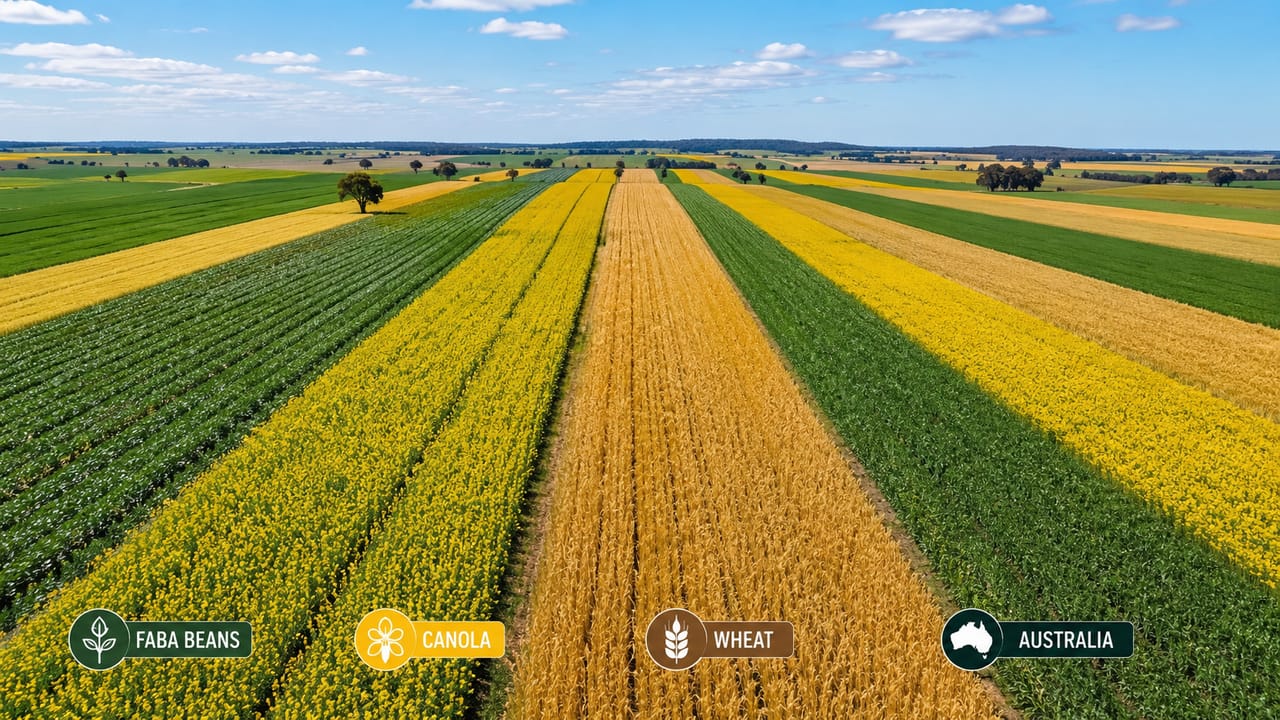
Because the pathogen survives for multiple seasons inside infected crop residues, reliance on chemical interventions alone is rarely sufficient. Instead, agronomic experts and researchers have long advocated for a holistic, integrated disease management (IDM) framework. Recent demonstration trials have shed new light on just how powerful cultural practices—specifically crop diversity and strategic crop rotations—can be in actively driving down pathogen inoculum levels in the soil.
Also Read: Soil Bacteria Stress Adaptation study
The GRDC-Backed Riverine Plains Trials: Location & Methodology
To evaluate the real-world impact of crop diversity and management choices on FCR, a series of comprehensive demonstration trials were conducted by the farming systems group, Riverine Plains, with investment from the Grains Research and Development Corporation (GRDC). These trials were strategically situated in commercial paddocks with historically high, laboratory-confirmed risks of Fusarium crown rot infection. The primary trial locations included:
- Mulwala (Southern New South Wales)
- Sanger (Northern/Southern New South Wales border region)
- Murchison (Northern Victoria)
The core objective of these trials was to demonstrate the efficacy of non-host break crops, evaluate various seed treatments, and highlight the critical role of pre- and post-harvest diagnostic testing in guiding tactical on-farm decision-making.
The Murchison Case Study: Crop Rotation vs. Soil Amelioration
At the Murchison trial site in northern Victoria, researchers focused heavily on a paddock characterized by acidic subsurface soils. While physical and chemical soil constraints were addressed using lime applications and strategic tillage, long-term monitoring revealed a fascinating agronomic insight: crop rotation exercised a significantly stronger influence on reducing FCR levels than changes in soil pH.
By shifting from a continuous cereal system to a diverse, multi-year rotational sequence, growers successfully broke the disease cycle. The progression of the rotation and its subsequent impact on FCR inoculum levels over a four-year window was highly illustrative:
| Year | Crop Sown | Functional Role in Rotation | FCR Inoculum Status |
|---|---|---|---|
| 2022 | Wheat | Susceptible Host Crop (Inoculum Build-up) | High / High Risk |
| 2023 | Faba Beans | Non-Host Pulse Break Crop (Decomposition begins) | Moderate (Declining) |
| 2024 | Canola | Non-Host Broadleaf Break Crop (Further decomposition) | Low |
| 2025–2026 | Wheat/Barley evaluation | Cereal Return Phase | Low to Undetectable |
This sequence illustrates the value of utilizing non-host broadleaf and pulse crops to starve the Fusarium pseudograminearum fungus. Without a living cereal host, the fungus is confined to surviving in old stubble, which naturally breaks down over time, taking the pathogen with it.
Cereal Choices: Is Barley Safer Than Wheat?
While a double break crop (such as faba beans followed by canola) is highly effective, farming economics often dictate that a cereal crop must be sown. In paddocks where FCR levels are elevated but a cereal is still required, the choice of species is critical. Trial observations indicated that barley often exhibited lower post-harvest FCR inoculum levels compared to wheat. While barley is still susceptible to infection and can act as a host, its rapid growth cycle and physiological differences can make it a more resilient option, offering a lower overall risk profile than highly susceptible bread wheat varieties.
Also Read: AI Revolutionizes Fish Behavior Study: Automated Cleaning
Analyzing Seed Treatments & The Limits of Unreplicated Trials
During the 2025 season, researchers evaluated various registered seed treatments across the Sanger, Mulwala, and Murchison sites. Surprisingly, the trials yielded highly variable results, with no clear, statistically significant yield differences observed between the treated cereal strips and the untreated control strips.
Sabita Duwal, Project Manager at Riverine Plains, explained that these findings highlight two critical lessons:
- The limitations of trial design: The seed treatment evaluations were conducted on unreplicated, single-strip configurations. In field research, unreplicated strips cannot account for natural paddock variability (such as soil moisture, topography, and localized inoculum patches). Without replication, researchers cannot statistically prove whether a positive or negative result was caused by the treatment or simply by the spot in the paddock where it was applied.
- The influence of seasonal conditions: The 2025 season was notably dry, yet the Riverine Plains region experienced an unusually cool finish. This cool weather reduced crop transpiration and moisture stress during the critical grain-fill phase. Because Fusarium crown rot expression is highly dependent on moisture stress, the crops did not experience the level of physiological stress required to trigger severe whitehead development, thereby masking any potential visual or yield benefits that the seed treatments might have provided.
Duwal emphasizes that chemical seed dressings should always be viewed as single tactical components of a broader Integrated Disease Management (IDM) strategy, rather than standalone silver bullets.
An Integrated Disease Management (IDM) Matrix for FCR
FCR management cannot rely on a single tool. Rather, it requires a systemic, proactive approach that spans multiple seasons. The table below details the core components of a modern, multi-pronged FCR defense strategy:
| Management Strategy | Primary Mechanism of Action | Pros | Cons / Practical Limitations |
|---|---|---|---|
| Non-Host Break Crops | Starves pathogen and allows infected crop residue to decompose naturally. | Highly effective; improves soil nitrogen (pulses); breaks weed cycles. | Subject to market volatility and local climate limitations. |
| Pre-Sowing Testing (PREDICTA® B) | Quantifies soil-borne pathogen DNA to map risk before planting. | Provides data-driven insight; prevents high-risk sowing mistakes. | Adds upfront diagnostic costs; requires careful soil sampling. |
| Inter-Row Sowing | Sows new crops between the standing stubble rows of the previous season. | Keeps new plant roots away from high concentrations of crown rot fungus. | Requires highly accurate RTK GPS autosteer and specialized machinery. |
| Resilient Variety Selection | Utilizes varieties with genetic tolerance or choosing barley over wheat. | Low-cost defensive measure built directly into the seed choice. | Tolerance does not mean complete immunity; yields can still suffer under high pressure. |
| Seed Treatments | Suppresses early-season fungal infection at the base of the plant. | Protects early root development and seedling vigor. | Highly variable efficacy under dry finishing conditions; does not eradicate the pathogen. |
Diagnostic Testing: Proactive Risk Management
The Riverine Plains trials strongly reinforced the absolute necessity of robust diagnostics in modern farming. Farmers are highly encouraged to use a dual-stage testing regime:
- Pre-Sowing: Utilizing industry-standard molecular diagnostic tools like PREDICTA® B allows growers to identify exactly which paddocks present a high risk before any seed is placed in the ground. If a paddock is flagged as high-risk, management can immediately shift to sowing a non-host break crop, such as canola, field peas, or faba beans.
- Post-Harvest: Stubble testing after harvest helps determine how much FCR developed within the crop during the season. This is crucial because, as seen in 2025, a mild or cool finish can prevent infected plants from showing physical symptoms (like whiteheads), despite high underlying pathogen levels in the stubble. Post-harvest diagnostics prevent growers from being caught off guard by high silent inoculum build-ups in subsequent seasons.
Conclusion: A Systems Approach to Cereal Health
The clear takeaway from the Riverine Plains and GRDC-funded trials is that managing Fusarium crown rot is not about finding a single cure-all chemical. Instead, it relies on a robust systems approach. By combining regular diagnostic testing, diverse crop rotations with non-host break crops, strategic variety selection, and mechanical techniques like inter-row sowing, growers can confidently drive down the FCR pathogen load, protect their soil assets, and secure high cereal yields for the future.
Interactive Crop Diversity & Fusarium Crown Rot Quiz
Test your knowledge on managing Fusarium crown rot with these ten multiple-choice questions based on the latest GRDC and Riverine Plains research.
REPORT CARD
ATTEMPTED QUESTIONS: 0CORRECT ANSWERS: 0
WRONG ANSWERS: 0
PRACTICE REGULARLY!
Frequently Asked Questions
What is Fusarium crown rot (FCR)?
Fusarium crown rot is a severe stubble-borne fungal disease in cereals, primarily caused by the pathogen Fusarium pseudograminearum, which restricts moisture flow and causes whiteheads and yield loss.
How do non-host break crops reduce FCR risk?
Non-host break crops (such as faba beans and canola) starve the FCR pathogen of host cereal material, allowing infected crop residues time to decompose and reduce the soil inoculum load.
What is PREDICTA® B?
PREDICTA® B is a DNA-based diagnostic soil test used by agronomists to quantify the risk of soil-borne pathogens, including Fusarium crown rot, prior to sowing.