
Ancient Seas Roared with 60-Foot Octopus Apex Predators
Imagine the oceans teeming with life during the age of dinosaurs. While we often picture fearsome marine reptiles and sharp-toothed sharks as the dominant predators, new research on fossilized jaws is rewriting our understanding of these ancient marine ecosystems.
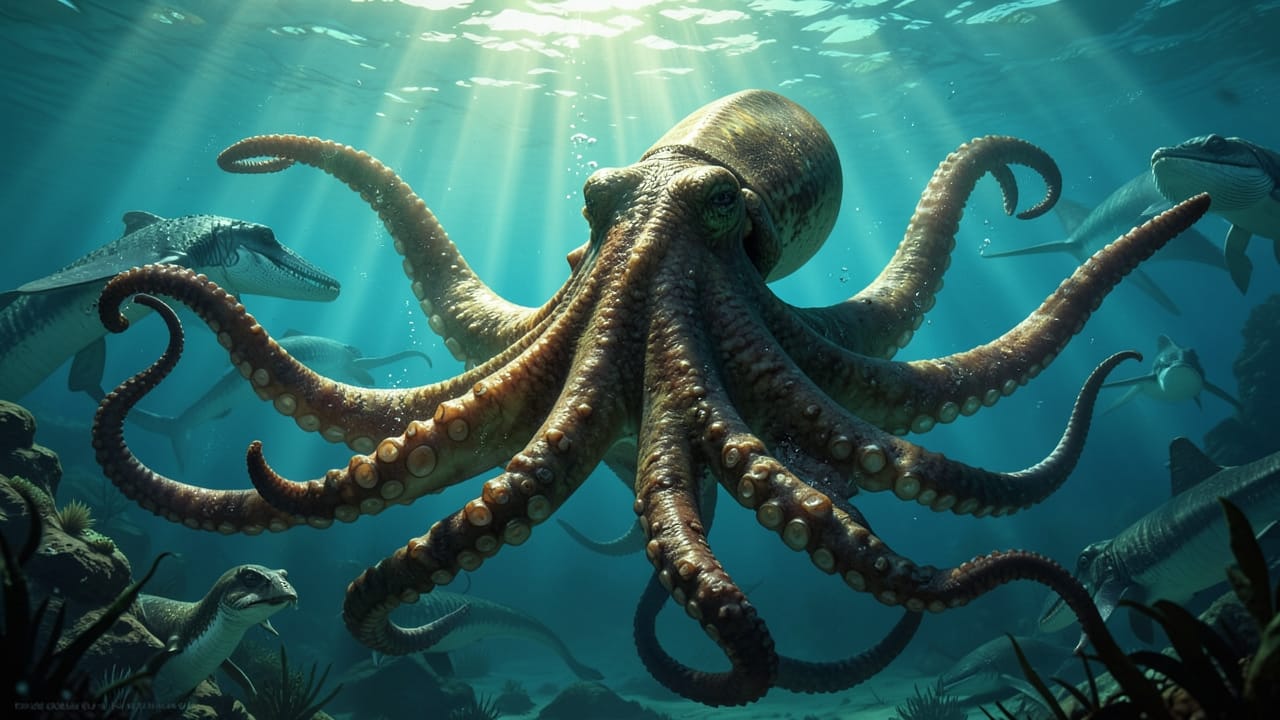
Evidence suggests that colossal, kraken-like octopuses, some reaching lengths of up to 60 feet, were also apex predators prowling these prehistoric waters approximately 100 million years ago.
Unearthing the Giants: The Power of Fossilized Jaws
For decades, the soft bodies of cephalopods like octopuses have made their fossilization a rare event. This lack of complete specimens has led to underestimation of their size and ecological role in prehistoric seas, a challenge often faced when studying giant beasts unearthed from different eras. However, a groundbreaking study, published in the journal Science, has utilized advanced techniques to analyze fossilized octopus jaws, revealing a far more imposing picture of these ancient invertebrates.
Researchers meticulously examined 15 ancient octopus jaws recovered from Japan and Canada's Vancouver Island. Furthermore, they employed a novel method called "digital fossil mining," which involves scanning rock cross-sections with high precision to uncover hidden fossils. This technique identified an additional 12 jaws from Japan. By comparing these ancient beaks to those of modern octopuses, scientists were able to estimate the immense size of these prehistoric creatures, with findings indicating lengths ranging from 23 to an astonishing 62 feet.
Also Read: Scottish Stone Age DNA Discovery: Male Dynasties Unearthed
Comparing Prehistoric Giants to Modern Cephalopods
The sheer size of these ancient octopuses is staggering. The largest fossilized jaw discovered was significantly larger than that of any known modern octopus. According to co-author and paleontologist Yasuhiro Iba of Hokkaido University, the predator is one of the largest invertebrates ever recorded. "Until now, the largest-known invertebrate has been the modern giant squid, which can reach about 12 meters (39 feet) in total length," Iba noted.
| Creature | Estimated Maximum Length | Era |
|---|---|---|
| Ancient Giant Octopus (e.g., 86-72 million years ago) | Up to 62 feet (approx. 18.9 meters) | Cretaceous Period |
| Modern Giant Squid | Up to 39 feet (approx. 12 meters) | Present |
| Largest Known Modern Octopus (Giant Pacific Octopus) | Up to 16 feet (approx. 5 meters) | Present |
Evidence of a Powerful Predator
The wear and tear on the fossilized jaws provided further clues about the feeding habits of these ancient octopuses. Scratches, chips, and rounded edges indicated that these creatures repeatedly crushed hard prey, such as shells and bones. This suggests they were formidable hunters capable of tackling a diverse range of marine life.
University of Alabama paleontologist Adiel Klompmaker, who was not involved in the new research, commented, "These krakens must have been a fearsome sight to behold." This discovery challenges the long-held perception that soft-bodied invertebrates were not significant players in the ancient food web, overshadowed by their vertebrate counterparts.
Ecological Significance and Future Research
The findings imply that these massive octopuses were likely apex predators, potentially competing with or even preying upon other formidable marine creatures of the time, such as mosasaurs and plesiosaurs. While their exact diet remains a subject of further investigation, their powerful beaks and flexible arms would have made them highly effective hunters, capable of consuming fish, snails, and potentially even smaller marine reptiles.
The study posits that the evolution of powerful jaws, coupled with the loss of external skeletons, allowed cephalopods and marine vertebrates to "convergently transform" into intelligent, large predators. Paleontologist Neil Landman of the American Museum of Natural History, who also did not participate in the study, highlighted the importance of continued exploration: "It's a big old planet. So we have lots to look at to piece together the marine ecosystem through time." Future discoveries of octopus fossils in various locations could provide a clearer picture of their role in ancient food webs.
Also Read: Bronze Age Diet: What Our Ancestors Really Ate
Clarifying Prehistoric Cephalopod Lineage
It's important to note that recent discoveries have also involved reclassifications. Earlier this year, a fossil previously believed to be the world's oldest octopus was re-identified as a relative of the nautilus, a shelled cephalopod. This underscores the ongoing evolution of our understanding of ancient marine life.
Start Quizzes [MCQs]
REPORT CARD
ATTEMPTED QUESTIONS: 0CORRECT ANSWERS: 0
WRONG ANSWERS: 0
PRACTICE REGULARLY!
Frequently Asked Questions
What new evidence suggests octopuses were apex predators during the age of dinosaurs?
The study focused on analyzing fossilized jaws, which, due to their durability, preserve better than soft body parts. Wear patterns on these jaws indicated they were used to crush hard prey, and their size allowed for estimation of the animal's massive dimensions.
Approximately how large could these prehistoric octopuses grow?
The research estimated that these ancient octopuses ranged from 23 to 62 feet in length, with the largest reaching nearly 60 feet.
Which technique was crucial for identifying additional fossilized octopus jaws in the study?
Digital fossil mining, a technique that closely scans rocks in cross-sections, was used to reveal fossils hidden within the rock.
What does the wear and tear on the fossilized jaws suggest about the ancient octopuses' diet?
The significant wear, including scratches and chips, indicates that these octopuses were powerful enough to crush hard-shelled or bony prey repeatedly.
Why has it been difficult to determine the size and role of ancient octopuses historically?
Unlike hard structures like bones and shells, the soft tissues of octopuses decompose quickly, making complete fossilization a rare occurrence and hindering previous estimations of their size and importance.
What is the current record holder for the largest known invertebrate before this octopus study?
Prior to this research, the modern giant squid, capable of reaching about 12 meters (39 feet), was considered the largest known invertebrate.
The study compares the ancient octopuses to which other famous marine reptiles of the Cretaceous period?
The article mentions that late Cretaceous-era waters were known to be ruled by sharks, mosasaurs, and plesiosaurs, placing the newly discovered giant octopuses in the context of these other major predators.
What material are octopus beaks made of, which contributes to their durability?
Octopus beaks are made of stiffened chitin, a tough material that allows them to crush shelled and bony prey effectively.
The researchers suggest that the evolution of large predators in the sea was a result of:
The study's authors stated that powerful jaws and the loss of superficial skeletons "convergently transformed cephalopods and marine vertebrates into huge, intelligent predators," indicating parallel evolutionary paths.
What did a recent reclassification reveal about a fossil previously thought to be the world's oldest octopus?
This earlier fossil, once thought to be the earliest octopus, was reclassified and determined to belong to a nautilus relative, highlighting the complexities in identifying and classifying ancient cephalopods.