
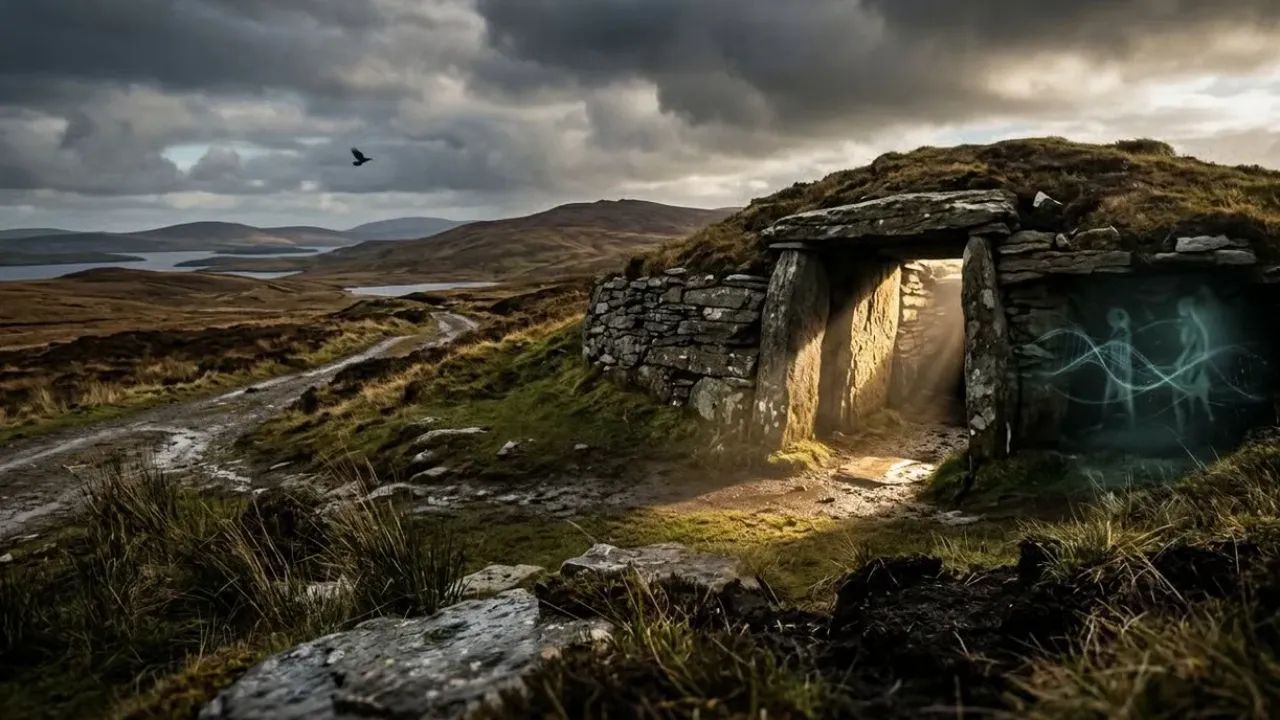
5,000-Year-Old DNA Reveals Secret Male Dynasties in Scottish Stone Age Tombs
A groundbreaking study, leveraging advanced DNA analysis of human remains, has unearthed compelling evidence of a highly structured and predominantly male-dominated social system in Scotland during the Neolithic period, approximately 5,000 years ago. The research, focusing on individuals buried in 'stalled cairns' across Caithness and Orkney, sheds new light on the intricate social hierarchies and kinship structures of Stone Age Britain.
Unveiling 'Webs of Descent' Through Ancient DNA
Scientists extracted DNA from 40 individuals interred in these monumental structures, revealing a fascinating 'web of descent'. This genetic mapping indicated that men from at least seven generations of male relatives were consistently buried in close proximity to one another within the same tombs. This suggests a patrilocal system, where men remained in their birth communities throughout their lives.
The 'family trees' reconstructed from this data point to a clear pattern: men stayed put, while women were more likely to migrate between communities upon marriage to establish new familial bonds. This movement of women appears to have been a significant factor in forging inter-community networks during the 4th millennium BC.
Stalled Cairns: More Than Just Burial Sites
The findings, published in reputable scientific journals like Cambridge University Press and Nature Communications, challenge the notion that these 'stalled cairns' were merely communal burial grounds. Instead, the research suggests they served as ancestral vaults for specific male lineages. The architecture of these tombs, featuring distinct stalls or compartments, is believed by archaeologists to mirror the compartmentalized nature of these male-centric social structures.
These monumental tombs likely played a crucial role in legitimizing the living descendants' claims to land and social status, acting as a physical manifestation of their genealogical connections to specific male ancestors.
The Science Behind the Discovery: Advanced DNA Extraction
The success of this research hinges on sophisticated techniques for dating and analyzing ancient human remains. Researchers utilized advanced methods, including 'petrous bone extraction' – a technique applied to a specific bone in the inner ear known for preserving high-quality ancient DNA, even from remains found in Scotland's acidic soils. These samples were processed at facilities like Harvard's Reich Laboratory.
By employing these cutting-edge approaches, scientists were able to reconstruct multi-generational lineages, extending over 250 to 300 years at individual tomb sites. This technological leap has allowed for an unprecedented glimpse into the biological and social organization of Stone Age societies.
Reconstructing Neolithic Social Structures
The study highlights a significant disparity in genetic diversity. While the mitochondrial DNA (inherited maternally) showed considerable variation, indicating the movement of women, the Y-chromosome DNA (inherited paternally) revealed a restricted pattern, supporting the idea of male lineage continuity within communities. This biological evidence strongly underpins the hypothesis of a patrilocal society.
Archaeologists from institutions such as the University of the Highlands and Islands and the University of Exeter propose that these tomb structures were not accidental; their design was intentional, reflecting and reinforcing the social order of the time. They served as tangible links to the past, providing a sense of continuity and belonging rooted in male ancestry.
Key Findings Summarized:
| Aspect | Discovery | Implication |
|---|---|---|
| Social Structure | Male-dominated, patrilocal | Men remained in birth communities; women migrated |
| Burial Practices | Men buried with male relatives across generations | Stalled cairns acted as male ancestral vaults |
| Kinship Networks | Women's migration fostered inter-community ties | Formation of social webs based on marriage |
| Tomb Architecture | Compartmentalized stalls | Mirrored the segmented nature of male lineages |
| DNA Analysis | High-resolution genetic mapping (Y-chromosome & mtDNA) | Provided biological evidence for social patterns |
Broader Implications for Understanding the Past
This research significantly advances our understanding of the complex social dynamics of Stone Age Britain. It moves beyond simple archaeological interpretations to incorporate robust genetic data, providing a more nuanced picture of how these ancient societies were organized, how kinship was traced, and how communities interacted. The study underscores the importance of monumental architecture in reflecting and reinforcing social hierarchies, and how advancements in genetic science can unlock secrets buried for millennia.
Stone Age Tombs Quiz: Test Your Knowledge
REPORT CARD
ATTEMPTED QUESTIONS: 0CORRECT ANSWERS: 0
WRONG ANSWERS: 0
PRACTICE REGULARLY!