
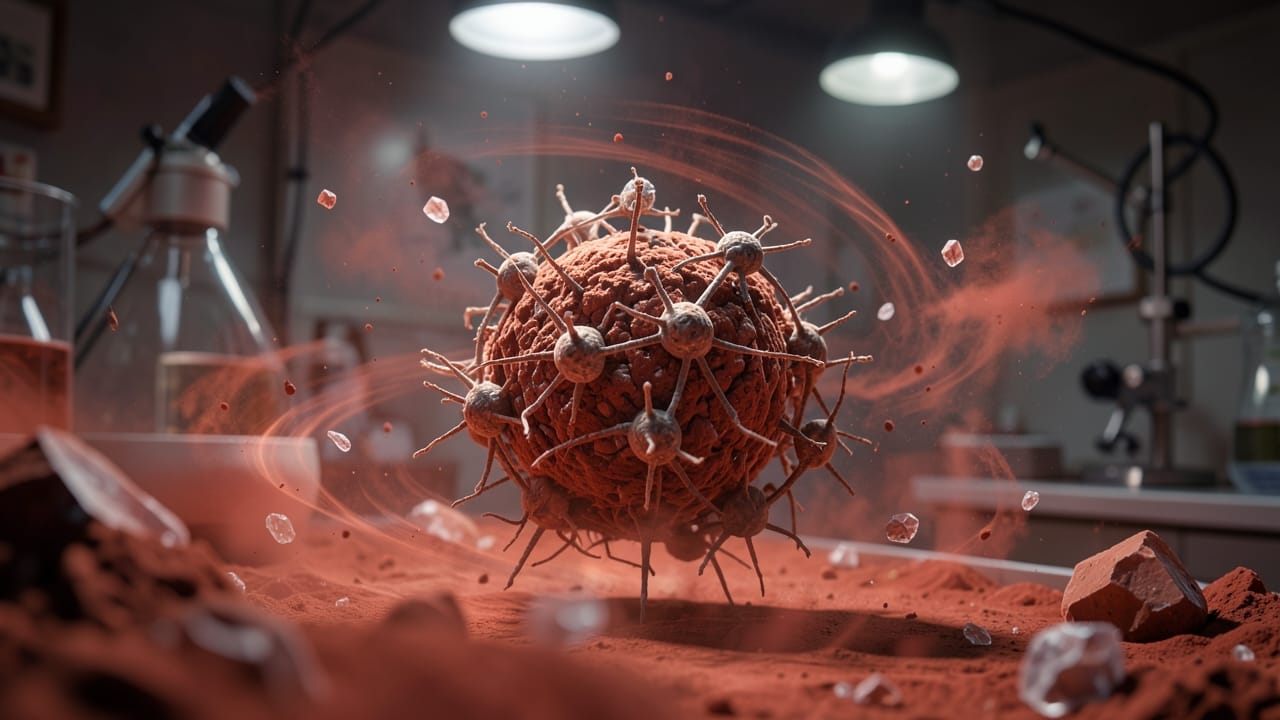
Microbial Survival Under Mars-Like Conditions: A Breakthrough in Astrobiology
In a significant advancement for astrobiology, scientists have successfully recreated the extreme conditions found on Mars in a laboratory setting, revealing surprising resilience in simple life forms. This groundbreaking research, published in the esteemed journal PNAS Nexus, challenges previous assumptions about the habitability of the Red Planet and expands our understanding of life's potential beyond Earth.
Recreating the Martian Gauntlet
The experiment meticulously simulated two of the most hostile features present on Mars: high-pressure shockwaves, akin to those generated by meteorite impacts, and the pervasive presence of perchlorate salts. Perchlorates are toxic chemical compounds known to exist in abundance within Martian soil, posing a significant threat to life as we know it.
Historically, scientists believed that such a combination of extreme pressures and toxic chemical environments would render any form of life incapable of survival. However, this recent study has overturned those notions, demonstrating that certain microorganisms possess remarkable survival mechanisms.
Also Read: Bus-Sized Asteroid 2026 HJ1: NASA Confirms Safe Earth Flyby + Quiz
Yeast Cells: Unexpected Resilience
The focus of the experiment was simple yeast cells, a eukaryotic microorganism often used in laboratory studies due to its genetic tractability and cellular similarities to more complex life. When subjected to the simulated Martian conditions – a dual assault of shockwaves and perchlorate toxicity – these yeast cells exhibited an unexpected degree of resilience.
The survival of these cells is attributed to their inherent ability to form protective molecular structures. These structures act as internal shields, safeguarding vital cellular components and maintaining essential functions even under immense external stress. This adaptive capability is reminiscent of extremophiles – organisms found on Earth that thrive in environments previously thought to be uninhabitable, such as deep-sea hydrothermal vents, polar ice caps, and high-radiation zones.
Static GK Fact: The Red Planet
Mars earns its moniker, the "Red Planet," from the abundance of iron oxide dust that covers its surface, giving it a distinctive reddish hue.
Significance for Astrobiology and the Search for Extraterrestrial Life
The implications of this study for astrobiology are profound. If simple life forms like yeast can endure the harsh conditions on Mars, it significantly bolsters the possibility that microbial life could have existed in the past or may even persist in subsurface environments on Mars today. This finding also has a direct impact on the concept of the "habitable zone" – the region around a star where conditions might be right for liquid water and life to exist. The study suggests that the boundaries of habitability may be far broader and more extreme than previously conceived, challenging traditional definitions.
Also Read: SpaceX Falcon 9 and Cygnus XL: ISS Resupply Mission, MCQs
Expanding the Limits of Life
The research underscores the incredible adaptability and tenacity of life. It forces a re-evaluation of what constitutes a biologically limiting environment and opens new avenues for future space exploration endeavors. Each discovery of this nature brings humanity closer to answering one of the most fundamental questions: Are we alone in the universe?
Scientists are quick to emphasize that survival does not equate to active growth or reproduction. While the yeast cells endured the simulated Martian onslaught, thriving and multiplying in such conditions remains a formidable challenge. Nevertheless, the mere survival itself is a monumental discovery.
Static GK Tips: Extremophiles and Martian Geology
- Extremophiles: These organisms are commonly found in extreme environments like hydrothermal vents and Antarctic ice, showcasing life's remarkable ability to adapt.
- Olympus Mons: Mars boasts the largest volcano in the solar system, Olympus Mons, a shield volcano approximately 25 kilometers (16 miles) high.
Implications for Future Missions
This research provides a crucial scientific foundation for upcoming Mars missions and exploration programs. It encourages a more thorough investigation of Martian soil and subsurface environments, seeking evidence of past or present life. The study also supports the ongoing search for biosignatures – indicators of past or present life – on other planets.
Comparative Analysis of Martian Environmental Factors
| Environmental Factor | Martian Condition | Experimental Simulation | Impact on Microbes |
|---|---|---|---|
| Pressure Waves | Meteorite impacts | High-pressure shockwaves | Potential cellular damage |
| Chemical Toxicity | Perchlorate salts in soil | Presence of perchlorate salts | Cellular dysfunction, dehydration |
| Temperature Extremes | Varying, very cold | Controlled laboratory temperatures (varied) | Metabolic slowdown, freezing damage |
| Radiation | High solar and cosmic radiation | Simulated radiation (not detailed in this article) | DNA damage, mutations |
Frequently Asked Questions (FAQ)
Q1. In which journal was the Mars survival study published?
A. PNAS Nexus
The study was published in PNAS Nexus, where scientists reported findings on microbial survival under simulated Mars-like conditions, contributing to ongoing research in astrobiology and space exploration.
Q2. Which organism was tested in the experiment?
A. Yeast cells
Yeast cells were used in the experiment to test their ability to survive extreme conditions, and their resilience demonstrated that simple life forms can tolerate environments previously considered uninhabitable.
Q3. Which chemical is commonly found in Martian soil?
A. Perchlorate salts
Perchlorate salts are toxic chemicals found in Martian soil, and their presence creates a hostile environment for life, making the survival of microorganisms under such conditions a significant scientific discovery.
Q4. Which field studies life beyond Earth?
A. Astrobiology
Astrobiology is the scientific field that studies the origin, evolution, and possibility of life beyond Earth, and this research contributes to understanding whether life could exist on planets like Mars.
Q5. What is the key conclusion of the study?
A. Cells can survive extreme conditions
The study concluded that certain cells can survive extreme conditions similar to those on Mars, although survival does not necessarily mean growth, and this finding expands our understanding of the limits of life.
Frequently Asked Questions
In which journal was the Mars survival study published?
The study was published in PNAS Nexus, where scientists reported findings on microbial survival under simulated Mars-like conditions, contributing to ongoing research in astrobiology and space exploration.
Which organism was tested in the experiment?
Yeast cells were used in the experiment to test their ability to survive extreme conditions, and their resilience demonstrated that simple life forms can tolerate environments previously considered uninhabitable.
Which chemical is commonly found in Martian soil?
Perchlorate salts are toxic chemicals found in Martian soil, and their presence creates a hostile environment for life, making the survival of microorganisms under such conditions a significant scientific discovery.
Which field studies life beyond Earth?
Astrobiology is the scientific field that studies the origin, evolution, and possibility of life beyond Earth, and this research contributes to understanding whether life could exist on planets like Mars.
What is the key conclusion of the study?
The study concluded that certain cells can survive extreme conditions similar to those on Mars, although survival does not necessarily mean growth, and this find expands our understanding of the limits of life.