
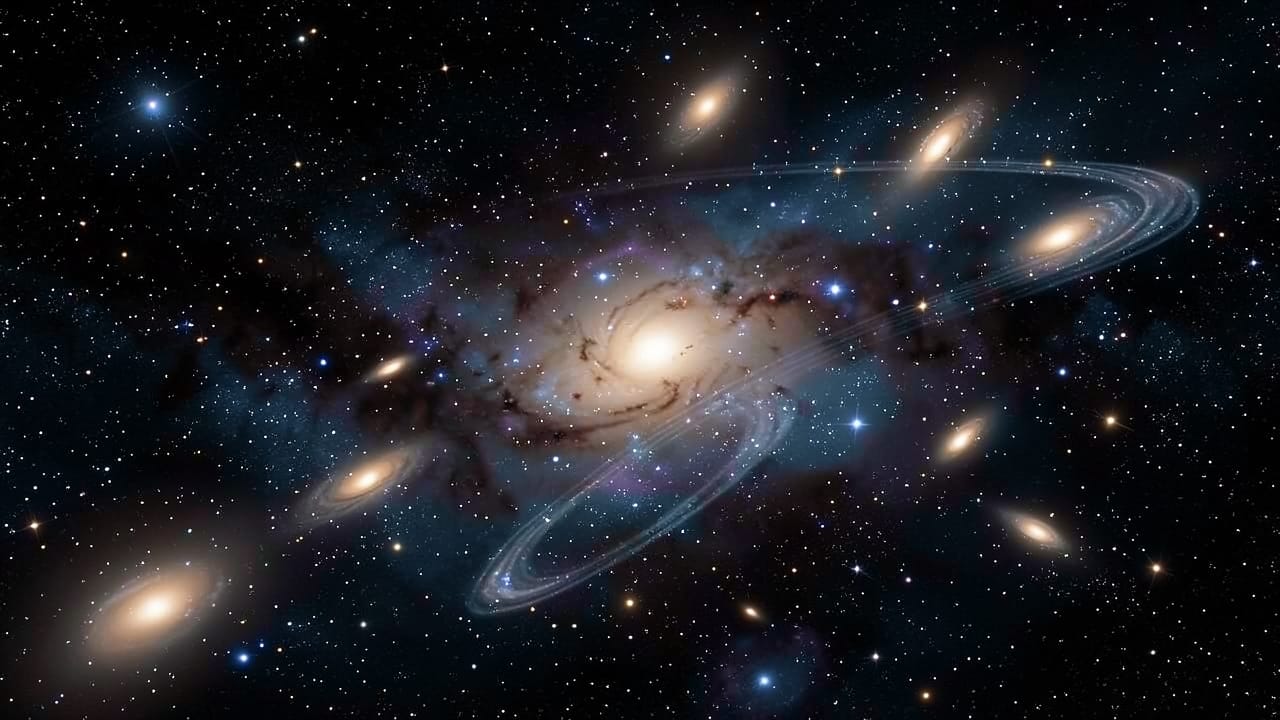
The Universe's Accelerating Expansion: A Cosmic Conundrum
Our universe is not only expanding, but its expansion is occurring at a pace that challenges our current understanding of physics. For decades, scientists have strived to accurately measure the rate at which galaxies are moving apart, a value encapsulated by the Hubble constant. However, persistent discrepancies in these measurements have created a significant dilemma, commonly known as the "Hubble tension," leaving modern physics grappling for an explanation.
Unraveling the Mystery: Observations and the Hubble Tension
The concept of an expanding universe was first posited by Edwin Hubble in 1929. Yet, contemporary observations reveal a more complex picture. Data derived from the cosmic microwave background (CMB), representing the faint afterglow of the Big Bang, suggests a slower expansion rate in the early universe. In stark contrast, observations of nearby galaxies, utilizing methods like supernovae as standard candles, indicate a significantly faster expansion rate. This disparity is not a minor deviation; it's a profound inconsistency that cannot be attributed to observational errors alone.
A pivotal study highlighted in Astrophysics by the Hubble Space Telescope (HST) and the SH0ES (Supernovae, H0, for the Equation of State of Dark Energy) team reported a highly precise measurement of the Hubble Constant:
"The Hubble Constant is now determined with an uncertainty of less than 2.4%, yet the discrepancy with early-Universe predictions persists."
This precision underscores the validity of the tension, pushing cosmologists to seek answers beyond simple measurement inaccuracies.
The Role of Dark Energy and Unforeseen Physics
The prevailing theory to explain the universe's accelerating expansion points to a mysterious entity known as dark energy. It is estimated to constitute about 68% of the universe's total energy density and is responsible for driving this acceleration. However, the fundamental nature of dark energy remains one of the most significant open questions in cosmology. Its properties could be evolving over time, which might reconcile the differing expansion rate measurements. Some theories even suggest that this discrepancy necessitates the existence of entirely new physics, extending beyond our current Standard Model of cosmology.
Potential Solutions and Future Investigations
The persistent Hubble tension has spurred scientists to explore a range of ambitious hypotheses. These range from potential revisions to Einstein's General Theory of Relativity to the possibility of undiscovered matter or forces influencing cosmic expansion. A 2020 study published in Nature Astronomy, titled 'Planck evidence for a closed Universe and a possible crisis for cosmology,' stated:
"If this tension does not result from systematic uncertainties, it can represent a case for new physics beyond the standard cosmological paradigm."
This has ignited considerable debate within the scientific community. Researchers are investigating theories such as 'early dark energy' or previously unknown interactions between cosmic components. The advent of next-generation telescopes and space missions, including the James Webb Space Telescope, promises to provide even more precise data. These advanced observational capabilities will be crucial for refining calculations, testing novel hypotheses, and potentially unlocking the secrets behind the universe's accelerating expansion.
What Lies Ahead?
The question of why the universe is expanding at an accelerated rate is not merely an academic pursuit. Its resolution could fundamentally alter our perception of reality and the cosmos itself. As scientists continue to gather and analyze data, the quest to understand cosmic acceleration remains one of the most compelling frontiers in scientific exploration.
Cosmic Expansion Quiz: Test Your Knowledge
REPORT CARD
ATTEMPTED QUESTIONS: 0CORRECT ANSWERS: 0
WRONG ANSWERS: 0
PRACTICE REGULARLY!
Frequently Asked Questions
What is the Hubble tension?
The Hubble tension refers to the significant and persistent discrepancy between the expansion rate of the universe measured from early universe observations (like the cosmic microwave background) and measurements from the local universe (using supernovae and Cepheid variables).
What is thought to cause the accelerated expansion of the universe?
Dark energy is the primary hypothetical force believed to be responsible for the accelerating expansion of the universe. It is thought to make up about 68% of the universe's energy density.
What are scientists considering as potential explanations for the Hubble tension?
Scientists are exploring various possibilities, including new physics beyond the standard cosmological model, modifications to Einstein's General Theory of Relativity, the evolving nature of dark energy, or the existence of undiscovered matter or forces.
What role does the Hubble Space Telescope play in this discussion?
The Hubble Space Telescope has been instrumental in providing highly precise measurements of the Hubble Constant using observations of Cepheid variable stars and supernovae, which have highlighted and quantified the Hubble tension.
What is the cosmic microwave background (CMB)?
The CMB is the faint afterglow of the Big Bang, a uniform bath of radiation filling the universe. Measurements of its properties provide insights into the conditions of the early universe, including its expansion rate.